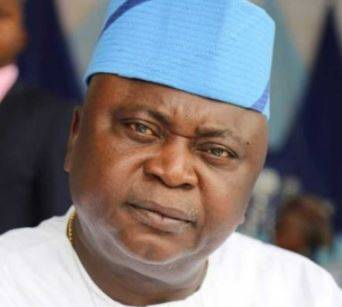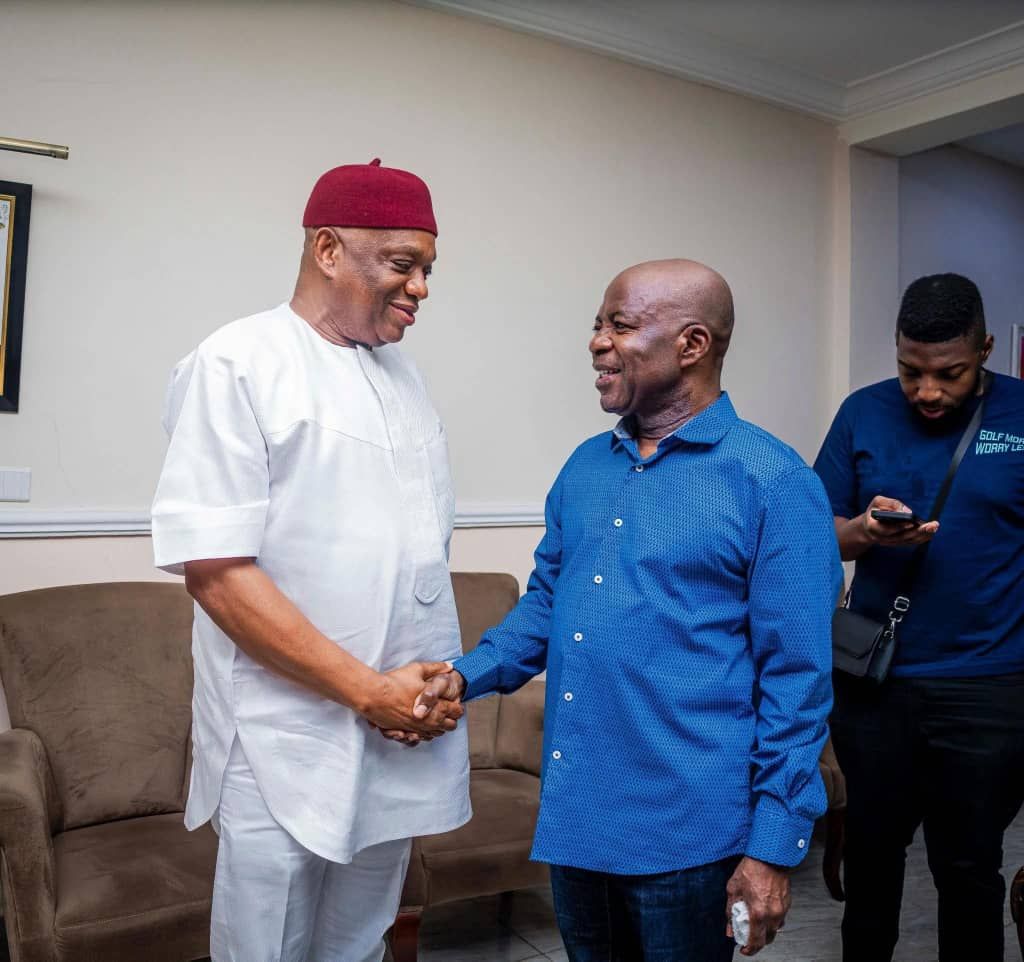
The recent public discourse in Abia State, fueled by critiques from the Bureau of Strategic Communication, invites a necessary re-evaluation of the political terrain in Abia. While the Bureau seeks to elevate Governor Alex Otti’s current administration through selective narratives, a factual and analytical perspective reveals that Senator Orji Uzor Kalu (OUK) remains a figure of enduring influence whose legacy provides the very foundation upon which modern Abia is built. Far from being a politician “worried” about the future, Kalu’s standing as an elder statesman and national leader positions him above the localized administrative friction currently emanating from Umuahia.
A central theme in the Bureau’s critique is the suggestion that Governor Otti is “reconstructing” a state that was left in ruins. However, history and current governance data tell a more nuanced story of continuity. In an era where the current administration celebrates road projects, it is vital to acknowledge that Senator Kalu governed Abia during a period of extreme national fiscal transition (1999–2007). Kalu did not just build roads; he established the state’s primary institutions. From the construction of the Abia State University Teaching Hospital (ABSUTH) to the stabilization of Abia State University (ABSU), Kalu’s tenure focused on human capital and institutional legacy.
Interestingly, Governor Otti himself acknowledged this reality as recently as June 2025, stating that his administration is “drawing from Kalu’s blueprint” to transform the state. To then have a subordinate office claim that no “OUK project” is worth repainting is not only a factual contradiction of the Governor’s own words but also an attempt to erase the skeletal infrastructure—such as the Aba Integrated Power Project’s early roots—that Kalu’s administration pioneered.
The Bureau dismisses Kalu’s observations on state revenue as “strange mathematics,” yet an analytical look at the Federation Account Allocation Committee (FAAC) disbursements supports Kalu’s core argument. In 2024 and 2025, Nigerian states received record-breaking allocations following the removal of fuel subsidies—sums that dwarfed the budgets of the early 2000s even when adjusted for inflation.
While a million Naira in 1999 held significant purchasing power, the total volume of funds available today for capital expenditure is unprecedented. Kalu’s critique is not a denial of inflation but a demand for a higher standard of output. He is pointing out that with the current “war chest” available to the state, the progress being celebrated should be exponentially greater than what was achieved in the resource-scarce years of the late nineties.
The Bureau’s attempt to frame Kalu’s influence as a “family hegemony” misconstrues the nature of political mentorship and longevity. In the volatile world of Nigerian politics, most leaders lose their relevance the moment they leave the Government House. Senator Kalu, conversely, has maintained a dominant presence in the National Assembly and as a leader in the ruling APC for decades.
This sustained relevance is not built on “political brigandage” but on a brand of grassroots connection that persists across generations. Kalu’s ability to attract federal projects to Abia North—ranging from massive rural road rehabilitations to solar street lighting—demonstrates that his influence is an asset to the state, not a threat. While the Bureau describes Kalu as “at the mercy” of political negotiations, the reality is that Kalu’s national standing as a former Chief Whip and current high-ranking Senator makes him the primary bridge between Abia State and the Federal Government.
The effort to pin pension arrears dating back to 2001 solely on Kalu is an oversimplification of a national systemic failure. The early 2000s marked a chaotic period for the Nigerian pension system before the 2004 Pension Reform Act. Almost every state in the federation struggled with the transition from the old “Defined Benefit” scheme. To blame a governor who left office nearly twenty years ago for arrears that persisted through three subsequent administrations is a tactical redirection of accountability. Factual analysis shows that the resolution of these arrears is a collective duty of the state, and Kalu’s administration managed the state’s payroll at a time when Internally Generated Revenue (IGR) was almost non-existent compared to today’s digitized tax systems.
Ultimately, the Bureau’s response reveals a deeper insecurity about the rising momentum of the APC in Abia State. Senator Kalu’s critiques of the Otti administration are not “salvos” of war but the observations of a veteran who has seen the cycle of governance many times over. Kalu is not a man muddled by a “new style” of governance; he is a man who understands that true leadership is measured by long-term stability and political infrastructure, not just the visual appeal of a fresh coat of paint.
By positioning himself as a loyal party leader focused on national unity and the re-election of President Bola Tinubu, Kalu operates on a plane that the Bureau’s local “strategic communication” fails to reach. The people of Abia are discerning; they recognize that while a new administration brings hope, it is the foundation laid by visionaries like Kalu that makes that hope possible.
Rubby Obinna
Jan. 9, 2026.