

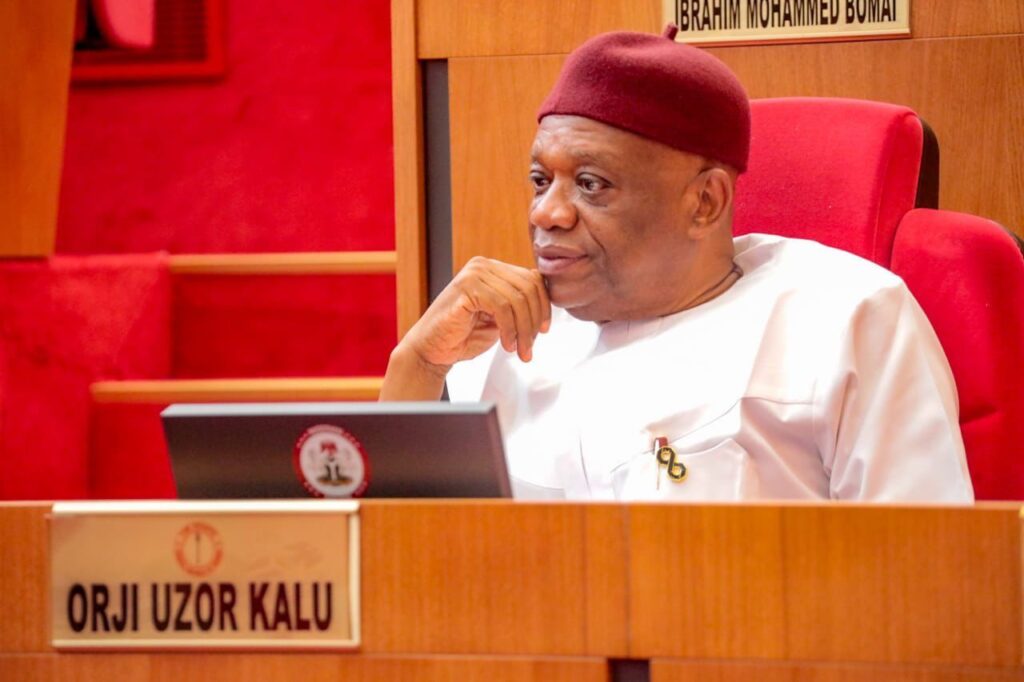
By Kenneth Udeh
Former Abia State Governor and Senator representing Abia North, Dr. Orji Uzor Kalu, has called for decisive investments, innovation-driven processing and stronger global trade integration to unlock the full potential of Nigeria’s cashew industry.
Kalu made the call in a keynote address delivered on his behalf by his Senior Legislative Aide, Barrister Emeka Nwala, at the 4th Nigerian Cashew Day 2026, held on Thursday at the Shehu Musa Yar’Adua Centre, Central Business District, Abuja. The event was themed “Unlocking the Full Potential of Nigeria’s Cashew Industry Through Investment, Innovation and Global Trade”.
Describing the forum as timely and strategic, Kalu commended the organisers for sustaining a platform that brings together policymakers, investors, processors, farmers and global trade actors around a shared objective of building a competitive Nigerian cashew industry.
“Unlocking the full potential of Nigeria’s cashew industry through investment, innovation and global trade speaks directly to where Nigeria must go as a nation diversifying our economy, deepening value addition, and expanding non-oil exports,” he said.
Nigeria’s Untapped Cashew Advantage
Senator Kalu noted that while Nigeria is already a major producer of raw cashew nuts, most of the value is still created outside the country, stressing that the gap between production and processing represents one of the clearest investment opportunities in the agricultural sector.
“Cashew is not just a crop; it is a full value chain farming, processing, packaging, logistics, exports, and by-products. Each stage offers scalable business opportunities with strong local and international demand,” he stated.
Highlighting investment as the key driver of growth, Kalu said Nigeria urgently needs more processing plants, modern storage facilities, export-ready packaging and integrated logistics systems.
Drawing from his personal experience in the sector through Igbere Food and Beverage Limited, he said his involvement was guided by the conviction that Nigeria must process what it produces.
“As the biggest cashew investor in Nigeria, our experience has shown that local processing significantly improves margins, creates jobs, stabilises farmer income, and positions Nigerian products for global markets,” Kalu said.
He outlined the major attractions of cashew processing for investors, including access to abundant raw materials, competitive labour advantages, growing domestic consumption and strong export demand across Europe, Asia and the Middle East.
According to him, Nigeria can replicate the success stories of countries such as Vietnam, Côte d’Ivoire, India and Guinea-Bissau, which have grown their economies significantly through the cashew industry.
Innovation, Value Addition and Global Trade
The lawmaker stressed that innovation must guide the sector’s growth, from improved seedlings and mechanised processing to quality control and product diversification.
“Beyond kernels, Nigeria can lead in cashew-based products snacks, beverages, butter, and industrial by-products. These innovations expand revenue streams and reduce waste across the value chain,” he said.
On global trade, Kalu emphasised that quality, consistency and traceability remain critical, urging Nigeria to align production and processing with international standards and certifications.
“Nigeria has the capacity to move from being a raw supplier to becoming a recognised global brand in cashew products,” he added.
Reaffirming the National Assembly’s commitment, Kalu said lawmakers would continue to support policies that encourage agro-processing, ease access to finance and protect investments, noting that government alone cannot drive the sector.
“The future of the cashew industry depends on strong partnerships between investors, processors, farmers, and development partners,” he said.
In his conclusion, the senator declared that Nigeria’s cashew industry is no longer a future prospect but a present business case.
“The resources are available, the market is ready, and the returns are real. What is required now is decisive investment, innovation, and collaboration,” encouraging local and international investors to explore Nigeria’s cashew value chain, he said.
The event featured panel discussions structured around key thematic priorities, including investment mobilisation, processing and value addition, sustainable finance, enabling policy frameworks, and climate-smart cashew production.
The panel session was moderated by Mr. Nathaniel Odiba, Head of Partnership, Grants and Events at Commodities Development Initiatives (CDI), with Mr. Herbert Idakwo, Managing Editor of Agribusiness Media Limited, serving as rapporteur.
Panelists included Mr. Ibrahim Sanfo, President of the African Cashew Alliance; representatives of the Federal Ministry of Agriculture and Food Security and the Federal Ministry of Industry, Trade and Investment; Dr. A.R. Adedeji of the Cocoa Research Institute of Nigeria; Alhaji Sheriff Tunde Balogun, President of the Federation of Commodity Associations of Nigeria; officials of the Nigeria Export Promotion Council and NEXIM Bank, as well as private sector leaders and state commissioners.
The forum also attracted high-profile dignitaries, including the Minister of Industry, Trade and Investment, Dr. Jumoke Oduwole, the Speaker of the House of Representatives, Abbas Tajudeen, the Minister of the FCT, Nyesom Wike, state governors, traditional rulers led by the Ooni of Ife, Oba Adeyeye Enitan Ogunwusi (Ojaja II), and the President of the National Cashew Association of Nigeria, Ojo Joseph Ajanaku, among others.
Participants described the 2026 Nigerian Cashew Day as a critical step toward repositioning Nigeria as a major global player in the cashew value chain.