

By Ranmilowo Ojalumo
For much of Nigeria’s Fourth Republic, the South-East has grappled with a persistent feeling of political distance from the centre of power. While the region has produced influential politicians, business leaders and technocrats, its relationship with the federal government has often been described in terms of marginalisation, missed opportunities and mutual suspicion.
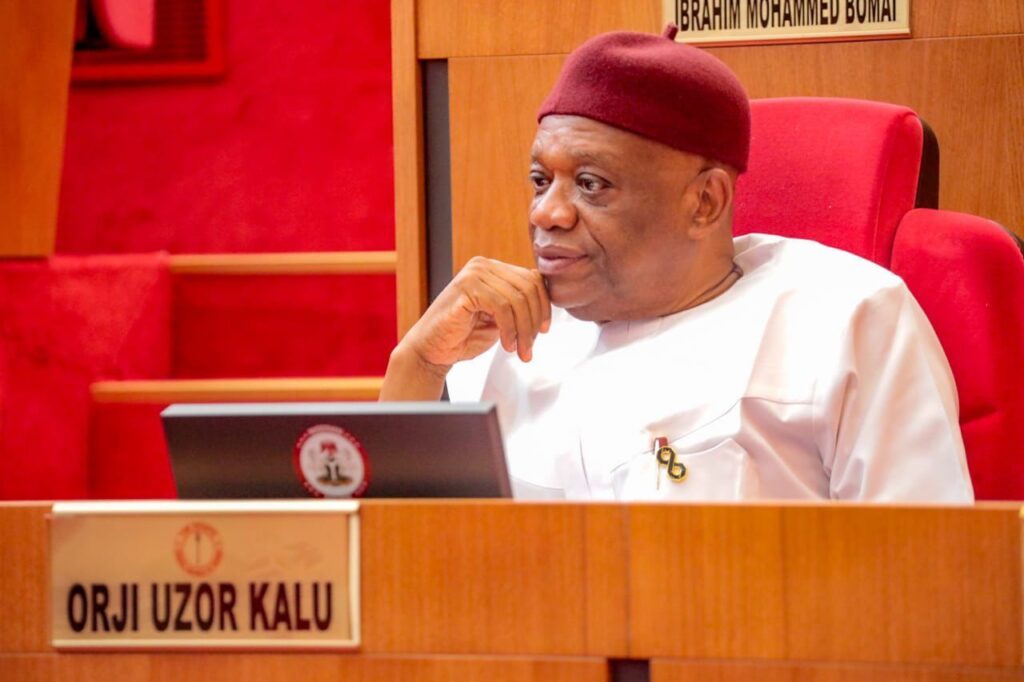
In this complex landscape, Senator Orji Uzor Kalu has increasingly positioned himself as a rallying point for efforts to reconnect the South-East to the centre, leveraging personal relationships, political pragmatism and an unusually outspoken national posture.
Kalu’s political journey is anything but conventional. A former governor of Abia State, two-term senator representing Abia North and one-time presidential aspirant, he has long defied easy categorisation. Where many South-East politicians have preferred cautious distance from the federal establishment, Kalu has chosen engagement, even when such engagement attracts criticism at home. His decision to align openly with President Bola Ahmed Tinubu and the ruling All Progressives Congress is central to this strategy, reflecting a belief that access, not isolation, is the currency of influence in Nigeria’s power equation.
At the heart of Kalu’s approach is the argument that the South-East cannot afford perpetual political detachment from the centre. In his public interventions, he has repeatedly framed participation in federal power as a pragmatic necessity rather than an ideological surrender.
For him, politics is strategic, as regions that negotiate, align and maintain presence at the centre are better positioned to attract infrastructure, appointments and policy attention. This philosophy explains his visible closeness to president Bola Tinubu, though a relationship built over years of political interaction before Tnubu became president, rather than sudden convenience.
Beyond personal relationships, Kalu has carved out a role as one of the South-East’s most vocal contributors to national discourse. Unlike many regional leaders who speak primarily on local or ethnic concerns, he has consistently weighed in on national economic reforms, security challenges, legislative priorities and governance issues. Whether defending controversial federal policies or calling for adjustments, his interventions are often framed in the language of national interest. This posture reinforces his self-image as a bridge figure, someone who speaks both as a South-Easterner and as a Nigerian stakeholder invested in the stability of the federation.
Critics within the region have accused Kalu of prioritising personal ambition over collective sentiment, particularly at moments when South-East grievances against the federal government run high. Yet supporters argue that his approach reflects political realism as confrontation without engagement has yielded little in tangible returns. From this perspective, it is obvious that Kalu’s strategy is less about individual gain and more about reopening channels that have long been weakened by distrust and political misalignment.
Kalu’s role in the National Assembly further underscores this positioning. As a ranking senator with influence across party lines, Kalu has often acted as an informal liaison between South-East interests and the federal executive. While such efforts rarely make headlines in dramatic fashion, they are part of the slow, behind-the-scenes bargaining that defines Nigerian federal politics. Roads, security interventions, institutional appointments and budgetary considerations are frequently shaped by access and advocacy rather than public protest alone.
Kalu’s proximity to Tinubu is particularly symbolic. Tinubu, a master of coalition-building, represents the archetype of centre power in contemporary Nigeria. By maintaining a visible and cordial relationship with him, Kalu signals to Abuja that the South-East is not uniformly oppositional, and to his region that engagement with the centre is possible without abandoning regional identity. This symbolism matters in a political culture where perception often shapes reality. Presence at the table, even without immediate rewards, can gradually recalibrate how a region is perceived within the national power structure.
At the same time, Kalu’s rhetoric has evolved to include appeals for South-East unity and strategic thinking. He has increasingly emphasised the need for the region to speak with a more coordinated political voice, arguing that fragmentation weakens bargaining power. While he does not claim to speak for all South-East leaders, his insistence on collective strategy reflects an awareness that personal access alone cannot substitute for regional consensus. In this sense, his role as a rallying point is as much aspirational as it is actual.
The broader significance of Kalu’s positioning lies in what it reveals about the changing nature of Nigerian politics. Ideological purity and regional protest, once central to political mobilisation, are increasingly giving way to negotiation and alignment. In this environment, figures like Kalu thrive because they are comfortable navigating ambiguity. He embraces the contradictions of being a regional advocate within a national power structure that does not always favour his constituency, betting that proximity and persistence will yield incremental gains.
Whether this strategy will ultimately transform the South-East’s relationship with the centre remains an open question. Structural challenges, historical grievances and internal divisions cannot be resolved by one individual, no matter how connected. Yet, politics often moves through symbols before it delivers outcomes. In that regard, Kalu’s visibility in Abuja, his readiness to defend engagement with the federal government, and his willingness to absorb criticism have already shifted the conversation.
Rather than framing the South-East solely as a region in opposition, Kalu presents it as a participant within the existing order. This reframing may not satisfy all constituencies, especially those who view resistance as a moral imperative. But for others, particularly political actors and business interests concerned with development outcomes, it offers a pragmatic alternative to prolonged exclusion.
Orji Uzor Kalu’s emergence as a rallying point reflects broader regional dilemma. The South-East stands at a crossroads between protest and participation, distance and engagement. Kalu has clearly chosen the latter path, positioning himself as a conduit to the centre and arguing that the cost of absence is higher than the discomfort of alignment. Whether history judges this approach as foresight or accommodation will depend not only on his actions but on how effectively the South-East leverages the openings he seeks to create.