

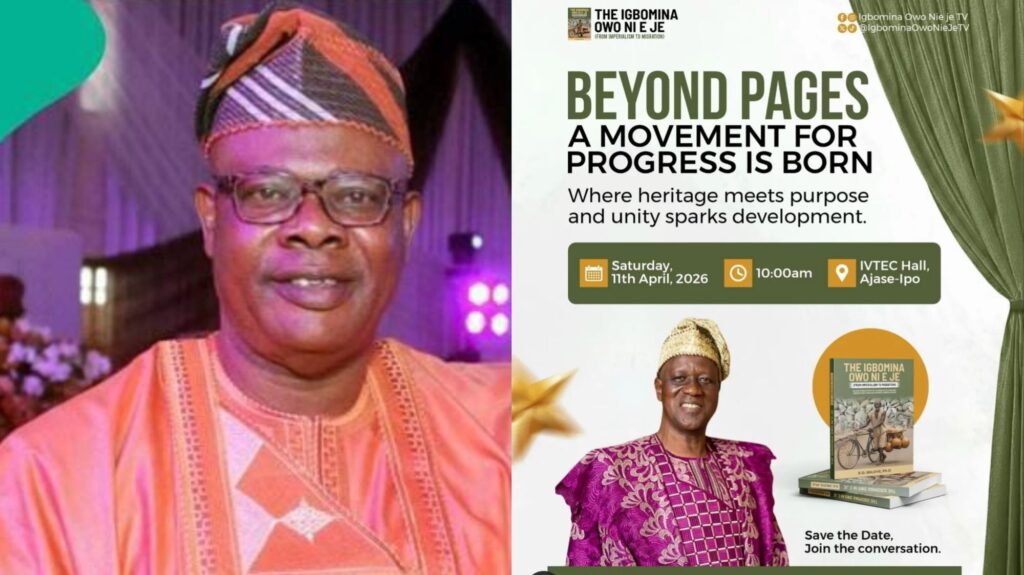
Veteran actor and cultural icon, Yinka Quadri, has applauded the publication of Igbomina: Owo Ni Ẹjẹ ahead of its official launch scheduled for Saturday, April 11, 2026.
The celebrated Nollywood actor shared his insightful review and personal reflections on the book, Igbomina: Owo Ni Ẹjẹ – From Imperialism to Migration, describing it as a timely and significant contribution to the documentation of Igbomina heritage and history.
According to him, the synopsis of the book captures a defining moment in the economic and developmental history of the Igbomina people, an important story that has largely remained untold.
His reflections highlight the importance of documenting the struggles, enterprise, migration, and resilience that have shaped the identity and progress of the Igbomina people over generations.
Yinka Quadri’s reflections on the book are presented below:
When I reflect on last weekend, I can honestly say it was one of those rare moments that make you pause and look deeply at your roots. Who really are you?
It was a bright Sunday morning. I had just completed my routine exercise when a brother of mine called to draw my attention to a yet-to-be-launched publication by Professor Emmanuel Olaniyi Ibiloye, a respected scholar of Economy and Migration History. The title immediately struck me: Igbomina Owo Ni E Jẹ: From Imperialism to Migration.
At first, I did not attach much importance to it. I simply asked him to send me more information. After our brief conversation, he forwarded a synopsis of the book. As I began to read, something unexpected happened. I found myself inside the story. Chapter after chapter, the book carefully examined the journey of the Igbomina people, a proud sub-group of the larger Yoruba race. It highlighted our struggles, resilience, survival, and above all, our entrepreneurial strength all over the world.
One section that truly held my attention was the account of the legitimate trade of Igbomina people in Lagos. It described how their business activities transformed their communities back home into places that became the envy of others. As I read, I saw my own journey reflected in those pages. My growth as an actor and movie producer is connected to that same culture of discipline, enterprise, and determination that defines the Igbomina spirit.
I could not help but remember the historic Awada Kerikeri Theatre Group, which brought together distinguished actors and actresses such as Adebayo Salami (Oga Bello), Pa Aluwe, and Iya Awero. The group was the brainchild of our late mentor, Ojo Ladipo, popularly known as Baba Mero, and was later led by the veteran actor Adebayo Salami.
Our first production, Ogun Ajaye, was shot in 1985 in Oro Community, a prominent town in Igbominaland of Kwara State. The choice of Oro was deliberate. At that time, the town had magnificent buildings and an enabling environment suitable for such a major production, something that was rare in many parts of Kwara State. That decision alone testified to the growing civilization and prosperity of Igbomina entrepreneurs in the 1980s. It is also noteworthy that several Duro Ladipo and Adelove-inspired productions were shot in Igbominaland.
I vividly recall that electricity was introduced to Oro Kingdom as far back as 1971. Community development had already begun to take shape in towns such as Igbaja, Esie, Ajase-Ipo, Ilala, Omu-Aran, Oke-Iya, and Arandun long before similar advancements reached other areas.
I also remember that in the 1980s, people from other communities within and outside Kwara State would visit Igbominaland just to see the magnificent edifices in various towns and villages, which were symbols of Igbomina success in their host cities. At a point, some people in Lagos even began to suspect that the Igbomina were ritualists because of their growing influence in the state’s economy during that period, a similar aspersion later labeled against the Igbos in the 21st century.
Our people were proactive in community development. In the 1980s, they constructed roads, built school blocks, and established hospitals through strong community associations and networks. These initiatives were communal efforts led by the first generation of Igbomina migrants who had achieved considerable success in business and were passionate about giving back home.
Politics was not initially their primary focus. They believed strongly in commerce and entrepreneurship as tools of empowerment. However, they supported their kinsmen who ventured into public office. I remember when the late Baba Olushola Saraki frequently visited my father at Dosumu in Lagos to coordinate meetings with prominent Igbomina businessmen at the Federal Palace Hotel. I personally drove my late father to many of those meetings around 1978 and 1979. These leaders later mobilized Igbomina sons and daughters across Lagos, Ibadan, Ife, and even Northern Nigeria during election periods. It reflected their unity, influence, and deep commitment to their homeland.
I was also told that the book will be launched for public consumption on Saturday, 11th April, 2026, at Ajase-Ipo. It will truly be an exciting moment to join in making history at the launch of this masterpiece.
Reading the Igbomina Owo Ni E Jẹ synopsis gave me deep joy because it captures our struggles and legitimate successes with clarity and scholarship. For the first time, I feel that the Igbomina people have spoken in their authentic voice.
I am proud to be part of this story. I am proud that this history has been carefully documented for generations yet unborn. And I remain committed to supporting this important cultural awakening for the progress of Igbominaland.
Alhaji Yinka Quadri
Agba Akin of Oro Kingdom.
