

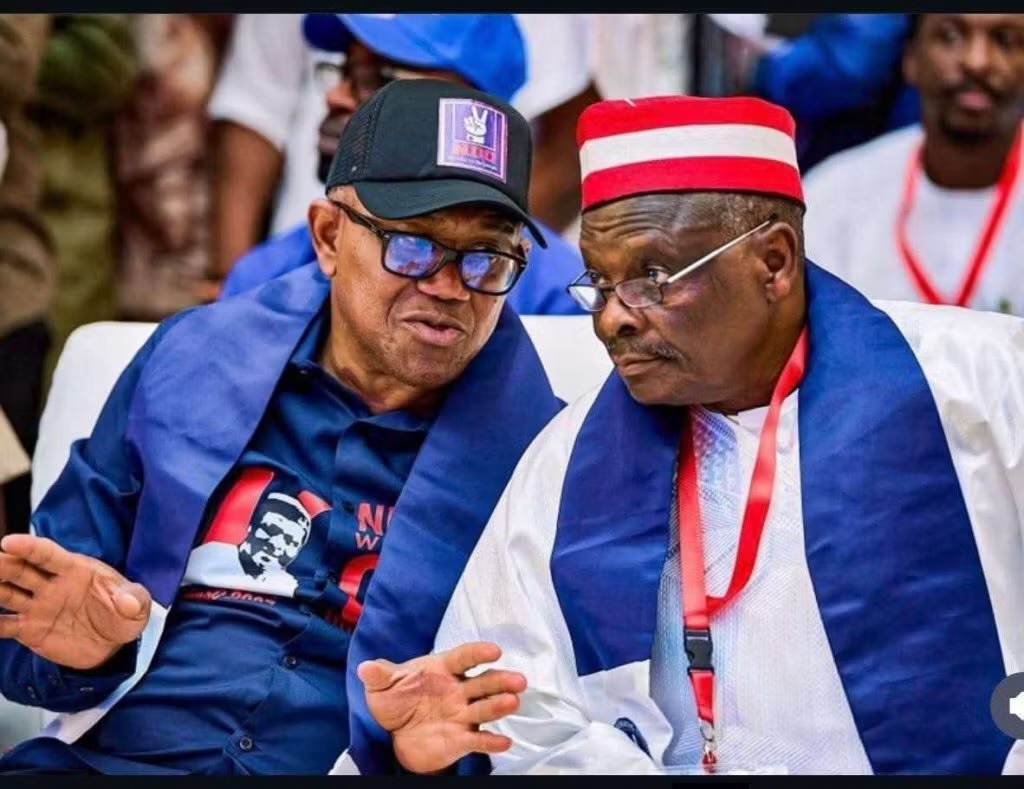
Former Kano State Governor and 2027 presidential candidate Peter Obi’s running mate, Rabiu Kwankwaso, has explained why he agreed to join forces with Obi ahead of the 2027 presidential election, saying national interest, equity and the need for political change influenced his decision.
Kwankwaso, however, dismissed the political relevance of some of his former allies in Kano, including former governors Ibrahim Shekarau and Abdullahi Ganduje, as well as incumbent Governor Abba Yusuf.
He made the remarks during the News Agency of Nigeria Personality Interview Series in Abuja on Sunday, while reflecting on his political journey and his decision to partner with Obi.
The former governor said his experience from the 2023 presidential election gave him a better understanding of Obi and convinced him that both politicians could work together to address the challenges confronting the country.
According to him, the decision followed consultations with members of the Kwankwasiyya Movement, supporters of the New Nigeria Peoples Party and the Obidient Movement.
He said the various groups agreed that the country needed a ticket capable of promoting national balance and attracting support from both the northern and southern parts of the country.
Kwankwaso also said the agreement was based on the understanding that the South should retain the presidency for one term after the completion of the eight-year tenure of former President Muhammadu Buhari, after which the political arrangement would return to the North.
“People learn every day, and that is why experience is very important. In 2023, we attempted to work together and at that particular point, I knew little about Peter Obi.
“But over these last four years, I was able to learn a lot and realised that Peter is somebody that I could work together with,” he said.
The former defence minister said worsening insecurity, declining agricultural productivity, economic hardship and deteriorating infrastructure had further strengthened his decision to support a political change in 2027.
He expressed particular concern over the difficulties confronting farmers in Northern Nigeria, saying agricultural production had become increasingly challenging and unprofitable.
Kwankwaso also criticised the state of infrastructure across the country, arguing that only a few areas, including parts of Lagos, had witnessed significant improvement.
He said Nigerians were once again looking for the type of political change that influenced the 2015 election, adding that the need for such change was now more urgent.
The former governor described the Obi-Kwankwaso ticket as a combination of regional balance, competence and credibility.
He said he was not concerned that accepting the vice-presidential slot amounted to a reduction in his political status, despite his previous experience as deputy speaker of the House of Representatives, governor, minister and senator.
“I have never been the vice president. I think it is a step forward despite all the things you counted,” he said.
Kwankwaso said his decision was not motivated by personal ambition, insisting that public office should be viewed primarily as an opportunity to serve.
“To me, being in government is to serve. I don’t have to be president. I don’t have to even be vice president. These are things that are in the hands of Almighty Allah,” he said.
He expressed confidence that Obi would honour the agreement between them and give the vice-president sufficient responsibility to contribute to governance.
Kwankwaso said his experience in government had taught him that effective delegation of responsibility to deputies strengthens an administration rather than weakens the principal.
He also rejected suggestions that his previous political discussions with President Bola Tinubu were driven by an attempt to secure a presidential or vice-presidential ticket.
According to him, his conversations with Tinubu after the 2023 election focused on possible cooperation and were not about abandoning the NNPP for a particular political position.
The former governor recalled his contribution to the APC’s victory in 2015, particularly the votes recorded in Kano, but said he later became dissatisfied with the party’s leadership.
Ganduje, Yusuf
Turning to Kano politics, Kwankwaso said political relationships built on betrayal rarely endure.
He cited former Governor Abdullahi Ganduje, who served as his deputy for eight years before succeeding him as governor in 2015, as an example.
Kwankwaso said Ganduje’s political fortunes began to decline after he fell out with him.
“If you can even see the issue of Ganduje, who we came together and supported, and became governor free of charge. The day when he started fighting was the beginning of his problem. If I may ask: where is he now? It is difficult to see him,” he said.
He argued that Ganduje would have retained greater political influence in Kano and beyond had he remained committed to the political structure they jointly built.
Kwankwaso also criticised Governor Abba Yusuf, whom he said was produced by the same political structure but had subsequently distanced himself from it.
He recalled that members of his political movement worked extensively to select Yusuf as their candidate in the 2019 governorship election.
According to him, Yusuf won the election before the result was overturned through litigation.
He said the same political structure backed Yusuf again in 2023 and secured his election as governor.
Kwankwaso, however, accused the governor of subsequently distancing himself from those who supported his political emergence.
“He left us, but he is not with Ganduje now. He is in between because I don’t think he is happy for anybody to call him Dan Gandujiyya,” he said.
He further alleged that Yusuf was attempting to emerge as the dominant political figure in Kano despite the influence of the structure that brought him to power.
Kwankwaso described the struggle for political control and succession as a recurring feature of Nigerian politics, saying Kano was only a particularly prominent example.
He recalled that President Tinubu had at one point asked him to reconcile with Ganduje, but said he responded by pointing to several politicians who had previously been close to the President but had since lost their prominence.
Among those he mentioned were former Lagos State Deputy Governor Kofoworola Bucknor-Akerele and former Lagos State Governor Akinwunmi Ambode.
Kwankwaso said political relationships were often temporary, with former allies sometimes becoming distant despite years of collaboration.
He, however, identified former Osun State Governor, Bisi Akande, as one of the political figures he still considered a friend.
Kwankwaso said the dynamics of political relationships were not unique to Kano but added that the experience in the state was particularly distinctive.
“It’s not very peculiar to Kano, but I think the Kano experience is special out of the general lots,” he said.