

By Sheriff A. Ibrahim, PhD
In the political landscape of Nigeria, the involvement of traditional institutions has often been a subject of controversy, debate, and misinterpretation.
Historically, traditional rulers in Nigeria have played significant roles in the nation’s journey toward independence and democratic consolidation.
During Nigeria’s struggle for independence, many traditional leaders used their influence to mobilize local populations, advocate for self-governance, and support pan-Nigerian unity. Figures like Oba Adeyeye Ogunwusi, the then Ooni of Ife, and the Sultan of Sokoto actively engaged in political discourse, fostering national unity and stability.
According to historical records, traditional rulers in Nigeria contributed to the mobilization of over 60% of rural populations for independence efforts and served as vital mediators in the transition from colonial rule to self-governance.
In the post-independence era, traditional institutions have continued to influence Nigeria’s democratic development by providing moral authority, mediating conflicts, and advocating for justice and fairness. Their involvement in political processes, especially in advocating regional and ethnic balancing, has helped sustain social cohesion in a complex, diverse nation.
In the lead-up to the 2023 elections, over 300 traditional rulers from the Southwest publicly backed a Southern presidency. They championed the bid of President Bola Ahmed Tinubu, arguing that after eight years of a Northern president, power should rightfully rotate to the South.
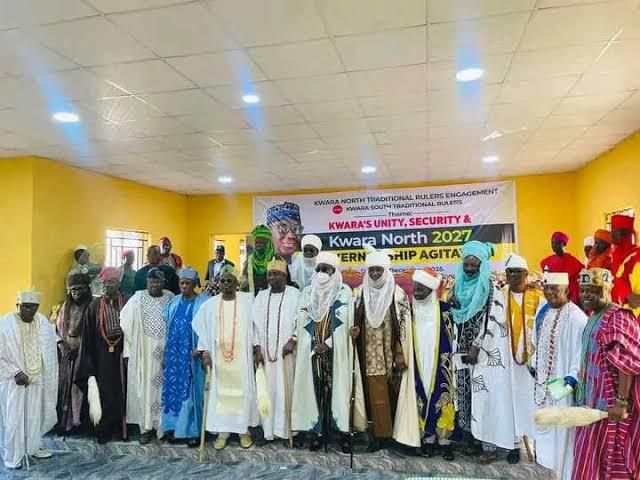
Therefore, any attempt to blackmail Kwara monarchs who have taken up the noble task of advancing the cause of justice, fairness, and equity at the sub-national level is misguided, as it follows a similar national precedent. Hence, it is morally and historically justified.
While traditional leaders are naturally non-partisan, endorsements of political candidates, support for zoning arrangements, and advocacy for fairness have often been grounded in their responsibility to promote justice and equitable representation.
In many state constituencies like Patigi, Oke-Ero, Isin, Edu, and a host of others where zoning arrangements are institutionalized, these royal fathers are instrumental to such arrangements that seek to ensure political balance and fair representation.
For instance, in 2014, traditional rulers in Kwara North endorsed Kwara South’s Governor Abdulfatah Ahmed’s re-election. Similarly, in 2019, these rulers were lobbied to give their buy-in to a purported zoning of the governorship to Kwara North in 2023, with the insinuation that if Rt. Hon. Atunwa emerged in the 2019 election, he would only spend a term.
This followed the conviction by PDP leaders at the time that Kwara North, which was supposed to get the guber ticket of the party in 2019, was actually ditched – a development that contributed to the consequent defeat of the Saraki-led PDP in 2019. The lobby for endorsement by the PDP was a demonstration of the monarchs’ longstanding role as mediators and guardians of justice, even in political matters.
However, their apprehension is understandable. Political opponents have previously and unduly exploited the stature of monarchs to serve personal or partisan agendas. A glaring example of this was during Dr. Bukola Saraki’s trial at the Code of Conduct Tribunal (CCT). During this period, some political actors, under the guise of defending Saraki, sought to manipulate traditional rulers by involving them in his personal legal battles, despite the fact that their role was not to engage in partisan disputes.
This was a clear abuse of the sanctity of the royal stools, turning revered monarchs into pawns for political expediency, which tarnished their neutrality and dignity.
It is bemusing that those desperately attempting to push the narrative of abuse of these monarchs’ stools have quickly forgotten the heavily controversial and arguably inappropriate role played by traditional rulers in 2004, during the administration of then-Governor Bukola Saraki, when the revered rulers were controversially gathered to welcome imported cattle flown in for the Zimbabwe farm project at Ilorin Airport.
The call for zoning to Kwara North is not a new phenomenon but a continuation of a longstanding tradition of regional and ethnic balancing in Nigerian politics.
The traditional rulers’ endorsement of Rt. Hon. Engr. Yakubu Danladi-Salihu reflects their understanding that equitable power distribution fosters stability and social cohesion, as they operate from a position of moral authority, representing the consensus of their communities and advocating for justice.
Moreover, their endorsement is not an attempt to meddle in partisan politics but a moral and cultural intervention aimed at ensuring that political power remains inclusive and representative. When they give their royal blessings, they are not engaging in partisan politics but affirming the principles of fairness, justice, and mutual respect – values that underpin sustainable development and national unity.
Regrettably, opposition forces and some political actors are aggressively trying to blackmail and discredit traditional rulers when their actions truly favor fairness and justice, which is both appropriate and necessary. Their involvement aligns with their historical role as mediators and custodians of fairness, promoting stability and unity within the diverse fabric of Kwara State.
The unfounded blackmail and attempts to discredit these revered custodians are not only unjustified but also hypocritical, especially considering the opposition’s past abuse for partisan interests.
As Kwara State continues to strive for equitable development and social cohesion, respecting the moral authority of traditional rulers and recognizing their contributions is paramount. Their voices for justice and fairness should be celebrated, not vilified.
