

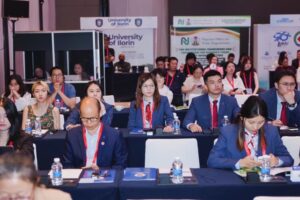
Vice-Chancellor of the University of Ilorin, Prof. Wahab Egbewole, SAN, has spotlighted the efforts of the institution in building a world-class Science, Technology and Innovation Park to advance the frontiers of research, industrial development, and economic growth in Nigeria.
Prof. Egbewole called for strategic collaboration between educational institutions and the private sector, especially in the areas of technology transfer, industrial development, research commercialisation and investment.
The Vice Chancellor made the call at the just concluded NACCIMA B2B Investment Matchmaking Exchange 3.0 in Guangzhou, China.

Key dignitaries at the high-level event included NACCIMA National President, Engr. Jani Ibrahim; Consul General of Nigeria in Guangzhou, Amb. Mairo Musa Abbas; Vice President China Council for the Promotion of International Trade (CCPIT), Huang Xiaofeng; among others.
Prof. Egbewole’s presentation brought an important institutional and academic dimension to the focus of the high-level event, which is how Nigeria can translate international business relationships into tangible economic development.
The programme was attended by over 200 Chinese investors, many of who took passionate interest in the investment proposals and projects pitched by the Vice Chancellor, especially the institution’s ambitious 200-hectare Science, Technology and Innovation Park in Kwara State.
The project, according to the VC, is designed to create an integrated ecosystem where academic research, industrial production, technological innovation and private-sector investment can co-exist to create enormous economic opportunities for the country.
The proposed park targets key sectors, including manufacturing, agriculture and Information and Communication Technology (ICT), while providing opportunities for technology companies, research institutions, start-ups and industrial investors to establish operations within the university environment.

According to details published by Innovation Report, UNILORIN is developing infrastructure, including roads, water and electricity, to support the proposed industrial and research ecosystem. The initiative will leverage the university’s existing research capacity, including approximately 52 patents, its laboratories, more than 70,000 students and a substantial pool of academic expertise.
This presents an opportunity for Chinese investors and manufacturers seeking credible Nigerian institutional partners for establishing production facilities, research centres, technology incubation hubs and joint ventures.
The broader message emerging from the NACCIMA Guangzhou B2B engagement is that Nigeria must position itself not only as a destination for imported goods but also as a competitive destination for investment, manufacturing, technology transfer and industrial production. China’s industrial development experience offers important lessons for Nigeria, particularly in building productive capacity, strengthening local industries and developing research-driven enterprises.
Through NACCIMA’s trade and investment facilitation activities, opportunities such as the University of Ilorin Science Park can be brought to the attention of credible international investors who are willing to establish businesses, transfer expertise and develop sustainable partnerships in Nigeria. This is also consistent with Nigeria’s ambition of building a $1 trillion economy by 2030, where industrial parks, manufacturing centres and export-oriented investments are expected to play significant roles.