

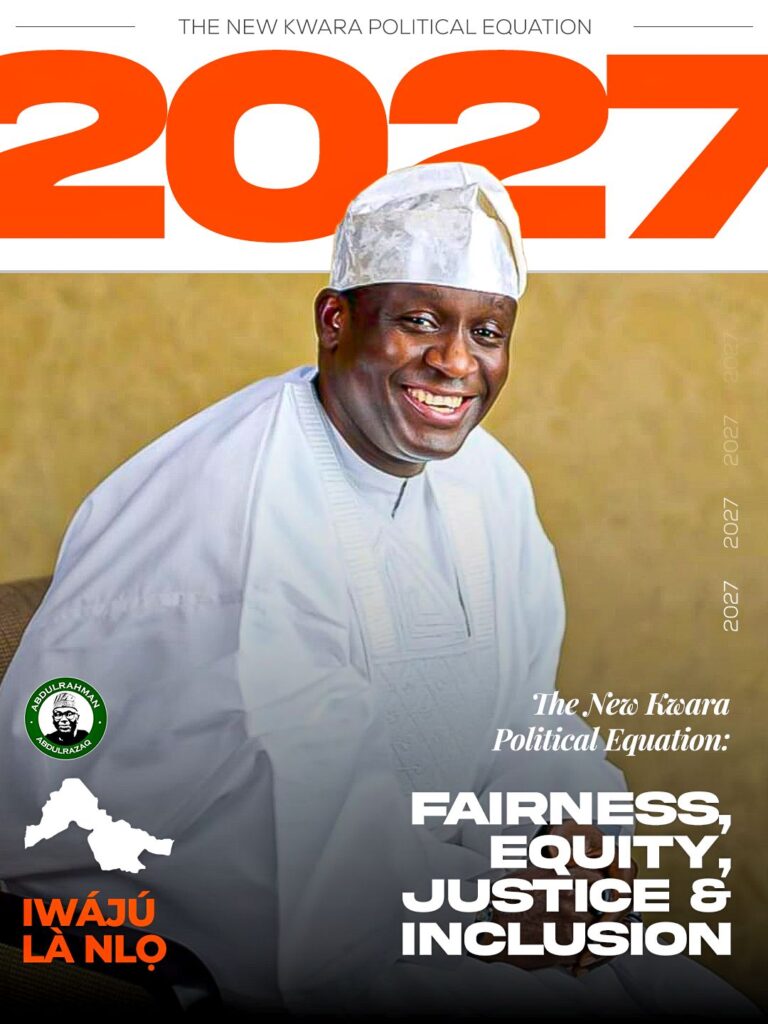
A new chapter in Kwara’s development must not begin by forgetting the lessons, sacrifices and gains of the chapter that preceded it.
There comes a defining moment in the life of every state when its people must look beyond political sentiments and ask a fundamental question: What kind of future do we want and what must we do to secure it?
The conversation about 2027 is not merely about who occupies the Ahmadu Bello house after Gov. AbdulRahman AbdulRazaq completes his constitutionally permitted terms. It is about the direction of a state that has spent the last seven years rebuilding, restoring public confidence and investing in areas that had suffered years of neglect.
It is about how the foundations being laid today will be strengthened tomorrow or whether Kwara will risk losing the momentum of its development journey for Egypt.
Moving forward means protecting progress, consolidating achievements and raising the standard of governance.
When AbdulRahman AbdulRazaq assumed office on May 29, 2019, he inherited a state facing serious institutional and developmental challenges. The administration publicly reported inheriting liabilities estimated at almost N100billion, considerably higher than the N30billion initially communicated by the outgoing government. There were also substantial outstanding gratuity obligations, struggling educational institutions and a healthcare system requiring urgent intervention.
Some public institutions had lost accreditation, basic school infrastructure was in poor condition and the state had been blacklisted from accessing UBEC funds because of outstanding obligations.
Healthcare delivery on the other hand faced equally troubling challenges. Essential programmes needed revitalisation, primary healthcare facilities required attention and access to reliable medical services remained a concern for vulnerable communities.
Seven years later, Kwara has acquired a different dimension.
Under Gov. Rahman, infrastructure renewal has become a major feature of the state’s development agenda while strategic projects have received attention to improve connectivity, commercial activity and access to essential services.
According to figures released by the state’s Commissioner for Works in December 2025, the administration had completed 302.4 kilometres of roads, with another 275.25 kilometres ongoing, alongside 294 kilometres under tax-credit road arrangements.
More than 8,000 teachers had been recruited and over 2,000 classrooms constructed. The administration also reported addressing outstanding teacher promotion arrears dating back to 2016.
Healthcare has equally featured in the administration’s priorities, with investments in primary healthcare facilities, medical equipment, personnel and access to services for vulnerable residents.
The effort to improve healthcare delivery is particularly important in rural communities, where the distance between a patient and an adequately equipped health facility can determine the difference between life and death.
Beyond physical infrastructure, the administration has pursued improvements in revenue generation, public financial management and workers’ welfare.
The state’s reported internally generated revenue increased from N30.6billion in 2019 to N87.1 billion as of December 2025. This administration has also implemented two minimum wage adjustments during its tenure.
The work is not finished. That is precisely why continuity matters. In fact, it strengthens the argument for a successor who understands the work ahead, appreciates the foundations already established and possesses the capacity to take the development further.
Governance should not be reduced to the personal ambition of whoever occupies an office, it should be measured by the ability to build systems that outlive individual officeholders.
As Gov. AA approaches the end of his tenure, Kwara must prepare for a transition that preserves institutional knowledge, protects ongoing investments and sustains the state’s development priorities.
Rt. Hon. Yakubu Salihu Danladi provides the platform for the party to present its case for continuity under a new administration.
The expectation is very clear: the next administration is not simply inheriting government buildings, official documents and ongoing projects. It is inheriting a responsibility to improve on the work already done, strengthen the education system, expand healthcare access, complete outstanding projects, address workers’ and pensioners’ concerns, create opportunities for young people and ensure that development reaches every part of Kwara.
It also demonstrates that continuity is not complacency, it’s a room for fresh ideas, accountability and innovation.
Kwara deserve a successor who understands that leadership is not about starting every policy all over again simply to establish a personal identity. It is about identifying what works and delivering better results.
The next electoral decision must therefore be informed by a clear understanding of what Kwara has experienced, what has improved and what remains to be done.
Political competition is healthy and the people have the ultimate authority to decide who earns their mandate.
But one principle should remain non-negotiable: Kwara’s development must never become a casualty of political rivalry. The state cannot afford to return to the cycle of institutional neglect that once weakened public services.
The next chapter must be stronger than the last.
It must be more ambitious, more inclusive, more responsive and more accountable.
MOVING FORWARD IS THE ONLY WAY FORWARD.
The next chapter must consolidate the gains and deliver even more for the people of Kwara.
#IwàjúLàNlọ!