

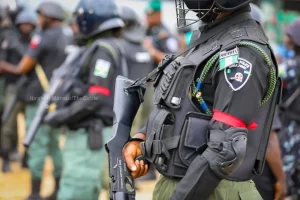
Opposition political parties have expressed doubts over the ability of state governments to establish and deploy state police before the 2027 general elections, warning that the proposed security arrangement could face operational challenges and possible political interference.
The African Democratic Congress, Peoples Democratic Party and Young Progressives Party said the time required to recruit and train personnel, procure equipment and establish operational structures could make it difficult for state police to become fully functional before the polls.
Their concerns come amid fears that incumbent governors could use the proposed security outfit to intimidate political opponents, suppress dissent and influence the electoral process.
However, the Federal Government and the National Assembly are working on additional legislation to establish safeguards against possible abuses by governors.
Senate Leader, Opeyemi Bamidele, disclosed this in an interview with Sunday PUNCH, saying the proposed legislation would provide operational guidelines for state police, define the boundaries between federal and state police authorities and prevent political interference.
**Opposition parties question readiness**
The National Publicity Secretary of the ADC, Bolaji Abdullahi, said concerns about governors using state police for political purposes were legitimate but argued that the 2027 elections were too close for the new security arrangement to become fully operational.
Abdullahi also faulted the process leading to the proposed establishment of state police, expressing concern over the lack of transparency.
He said, “The fear is real that state governors could abuse state police in furtherance of their political agenda. Unfortunately, we have not seen details of the bill to be able to make informed commentary.
“It is too late for institutionalisation and administration for state police to take off. ADC supported state police, but we are worried about the secrecy of the process that has brought us to this stage.”
Similarly, the National Publicity Secretary of the YPP, Wale Egbeola-Martins, said the period between the expected presidential assent in December and the 2027 elections would be insufficient for states to establish functional police structures.
He argued that the proposed security outfit was unlikely to be ready in time to influence the elections or be deployed against political opponents.
Egbeola-Martins, however, said his party was yet to examine the full provisions of the proposed legislation to determine whether adequate safeguards had been provided against possible abuses.
He urged governors to exercise their powers responsibly, warning that state policing should strengthen national security rather than become an instrument of political oppression.
The PDP also dismissed immediate fears that governors could use state police to manipulate the 2027 elections, arguing that recruitment, equipment procurement, logistics and training would take considerable time.
The party’s National Publicity Secretary, Jungudo Mohammed, urged Nigerians to assess the proposal beyond the next general elections, saying decentralised policing was necessary to address the country’s security challenges.
He acknowledged concerns about possible political abuse but maintained that such fears should not overshadow the need to improve the country’s security architecture.
**Senate plans safeguards against abuse**
Amid the concerns, Bamidele said the National Assembly was working with the executive arm of government on a separate bill to address issues that might not be adequately covered by the proposed constitutional amendment.
He said the legislation would clarify the respective responsibilities of the Police Service Commission and the proposed state police service commissions, their leadership structures and the circumstances under which federal police authorities could intervene in matters involving state police.
According to him, lawmakers are exploring measures to insulate the proposed security outfit from political interference, regardless of the party controlling a state.
Bamidele said the proposed bill would be developed in consultation with relevant stakeholders and would establish the operational framework for state police.
He explained that while the constitutional amendment would provide the legal foundation for state police, detailed provisions governing their operations would be contained in a separate Act of Parliament.
The Senate Leader added that the existing Police Act would also be amended to reflect the new arrangement, with separate legal frameworks for the Federal Police and state police.
He said the proposed legislation would follow presidential assent to the constitutional amendment bill seeking to move police affairs from the Exclusive Legislative List to the Concurrent Legislative List.
**LP, NNPP, APM demand safeguards**
Meanwhile, the Labour Party, New Nigeria Peoples Party and Allied Peoples Movement have called for stronger safeguards to prevent governors from turning state police into political instruments.
The National Publicity Secretary of the LP, Ken Asogwa, said concerns about governors using state police to target political opponents were justified, citing the conduct of some governors under the existing centralised policing system.
He, however, cautioned against allowing fears of political manipulation to frustrate the establishment of state police, given the country’s worsening security situation.
Asogwa called for constitutional safeguards to prevent possible abuses and argued that Nigeria needed to move away from the centralised policing structure inherited from the colonial administration.
Also, the National Chairman of the NNPP, Major Agbo, acknowledged the possibility of governors manipulating state police but said the priority should be putting measures in place to prevent such interference.
He described state police as a worthwhile initiative, insisting that the possibility of abuse should not stop the country from adopting a decentralised policing system.
Agbo called for a review of the laws and regulations governing the proposed structure to limit the influence of governors and other state institutions.
Similarly, the National Publicity Secretary of the APM, Abubakar Yusuf, warned that political interference and overlapping responsibilities could undermine the effectiveness of state police.
He urged lawmakers to clearly define the operational framework and responsibilities of the proposed security outfit, insisting that it must be insulated from political influence.
