

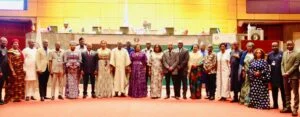
The ECOWAS Parliament has called on member states to strengthen regional efforts against child trafficking and labour, urging governments to turn existing laws and commitments into concrete measures to protect vulnerable children.
The Speaker of the Parliament, Memounatou Ibrahima, made the call at a regional parliamentary workshop on combating child trafficking and child labour during the Parliament’s 2026 Ordinary Session in Abuja on Saturday.
Ibrahima said the continued exploitation of children through trafficking and hazardous labour violated their fundamental rights, undermined their education, health and development, and threatened the future of the West African region.
She expressed concern over the gap between governments’ commitments to child protection and the realities facing millions of vulnerable children across the sub-region.
“When a child is a victim of trafficking or subjected to labour that undermines his health, schooling or development, this means that its most basic human rights are being undermined,” she said.
The Speaker noted that despite commitments by member states and the establishment of protective frameworks, implementation remained weak due to inadequate funding, poor enforcement of sanctions and ineffective coordination among institutions.
She urged parliamentarians to assess the impact of existing interventions and determine how many children had been rescued, protected and successfully reintegrated into society.
Ibrahima said national parliaments must strengthen relevant legislation, scrutinise budgetary allocations, monitor government policies and hold institutions accountable for protecting children.
She added that the ECOWAS Parliament had a responsibility to facilitate consultations among member states, develop common recommendations and promote stronger regional cooperation.
Recalling that a similar workshop was held in May 2023, she stressed the need for sustained parliamentary monitoring to ensure that previous recommendations translated into measurable results.
She urged participants to produce practical recommendations, assign clear responsibilities and establish realistic follow-up mechanisms instead of ending the workshop with another set of general commitments.
Speaking at the event, ECOWAS Commissioner for Human Development and Social Affairs, Prof. Nassirou Bako, disclosed that trafficking victims in the region increased by 31 per cent between 2019 and 2022.
Bako said children accounted for 47.9 per cent of the 12,959 unidentified persons captured in statistics presented at the workshop, highlighting their vulnerability to trafficking and exploitation.
He said available data from member states showed significant cases of human trafficking, although the figures remained incomplete because some countries had yet to submit their statistics.
According to him, Benin recorded 4,015 identified trafficking victims in 2025, with young women accounting for 84.7 per cent, while Nigeria recorded 1,684 cases, including 46.7 per cent involving children.
The commissioner identified insecurity, terrorism, displacement and political instability as factors increasing children’s exposure to trafficking, forced labour and other forms of exploitation.
He said conflicts and displacement had disrupted education and weakened family protection systems, citing about 8,450 schools affected and 4.1 million people displaced.
Bako warned that out-of-school children, those separated from their families and those exposed to poverty and social exclusion faced increased risks of trafficking and exploitation.
He also expressed concern over the recruitment of children by armed groups, including Boko Haram, and their exploitation under the guise of education and religious instruction.
The commissioner said ECOWAS had introduced several interventions, including humanitarian assistance, family reunification for separated children, regional programmes and support for trafficking victims.
He disclosed that convictions for trafficking-related offences across the 12 ECOWAS countries increased from 388 in 2024 to 515 in 2025.
However, he said the interventions remained inadequate given the scale of the crisis, particularly the limited resources available for rehabilitation, reintegration, victim support and access to education.
Bako further highlighted the region’s weak social protection systems, noting that only about 10 per cent of West Africa’s population benefited from some form of social protection.
He compared the figure with 18.5 per cent across Africa and approximately 50 per cent globally, warning that inadequate social protection increased poverty and vulnerability.
He urged parliamentarians to support the establishment and strengthening of social registries across member states to improve data collection and identify vulnerable populations.
He also advocated victim support funds at national and regional levels, increased investment in rehabilitation and vocational training, and expanded social protection programmes.
Bako called on lawmakers to use their oversight powers through investigations and visits to communities affected by trafficking and child labour to recommend appropriate government interventions.
“We need the parliament,” he said, stressing that the ECOWAS Commission required stronger legislative backing, adequate funding and effective oversight to address the challenge.
Similarly, Senior Programme Officer of the Inter-Parliamentary Union, Akiyo Afouda, said nearly 138 million children worldwide remained engaged in child labour, including 46.6 million in sub-Saharan Africa.
Afouda, who represented the IPU Secretary-General, said figures published in 2025 by the International Labour Organisation and UNICEF underscored the urgent need for stronger interventions.
He described a situation in which millions of children were deprived of education, exposed to exploitation and forced into dangerous jobs, with some abducted from their families and communities.
Afouda said child trafficking and labour were not only human rights violations but also major obstacles to economic development, social cohesion and
