As political realignments gradually gather momentum ahead of the 2027 general elections, the conversation around equity, fairness, and inclusion within the Ifelodun/Offa/Oyun Federal Constituency must be brought to the front burner.
At the heart of this discussion is a simple but compelling question: when will Ifelodun Local Government, particularly the Omupo axis, be given a fair opportunity to represent the constituency at the House of Representatives?
For years, the Ifelodun/Offa/Oyun seat has largely revolved around Offa and Oyun, with Ifelodun playing a less prominent role in occupying the position. While political realities often shape outcomes, there comes a time when justice and balance must guide decision-making—and that time is now.
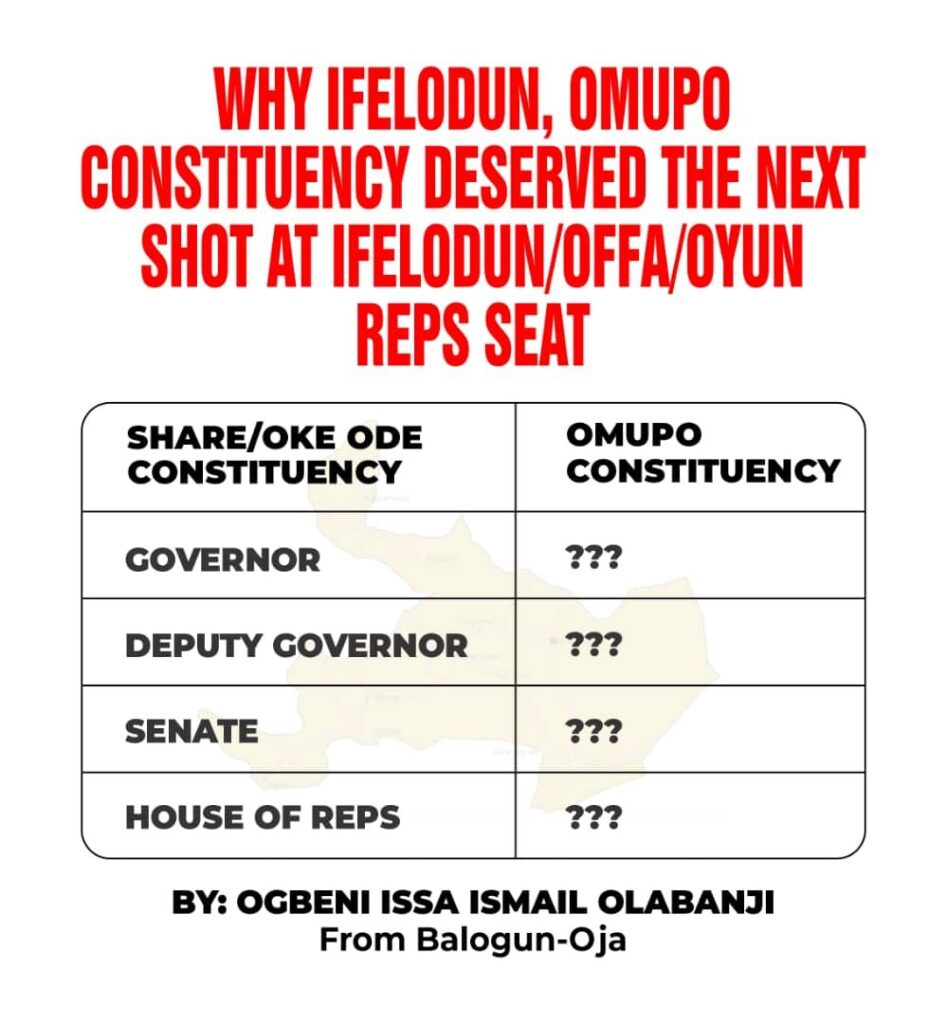
Even within Ifelodun Local Government, the principle of equity has not been evenly reflected. The local government comprises two state constituencies—Omupo and Share/Oke-Ode. However, a closer look at the distribution of key political opportunities reveals a pattern that cannot be ignored.
The Share/Oke-Ode axis has consistently produced top political office holders. From Abdulfatah Ahmed, who served as Governor of Kwara State, to Elder Kayode Alabi, the current Deputy Governor from Oro-Ago, and Makanjuola Suleiman Ajadi, a former Senator from the Adio axis, the narrative remains the same.
Even at the federal level, the brief representation by Alhaji Kola Shittu from Oke-Ode further underscores the dominance of this bloc.
This is not to diminish their contributions but to highlight the urgent need for internal balancing within Ifelodun itself. Equity is not just about rotation among local governments; it must also reflect fairness within them.
The Omupo constituency, despite its political relevance and contribution to the party structure, has yet to fully benefit from such high-level representation. This reality strengthens the argument that zoning the House of Representatives seat to Ifelodun—and more specifically to the Omupo axis—is not only fair but necessary.
Zoning, when applied sincerely, promotes unity, reduces tension, and fosters a sense of belonging among all stakeholders. It assures every segment that they are valued and have a stake in the political process. Ignoring this principle risks alienating communities and weakening party cohesion.
As such, party leaders, stakeholders, and faithful of the All Progressives Congress (APC) must approach this moment with sincerity and foresight. The call for equity should not be treated as mere political rhetoric but as a genuine pathway to strengthening internal democracy and fairness.
If the decision is made to zone the seat to Ifelodun Local Government, it is only just and reasonable that serious consideration be given to credible aspirants from the Omupo constituency. This would not only correct longstanding imbalances but also deepen inclusiveness within the political framework.
Ultimately, this is not just about politics—it is about justice, recognition, and the sustainable unity of the constituency. When equity is allowed to prevail, everyone wins.
The time to act is now.
Ogbeni Issa Ismail Olanbanii Writes from Balogun-Oja