By Monsurat Abisoye
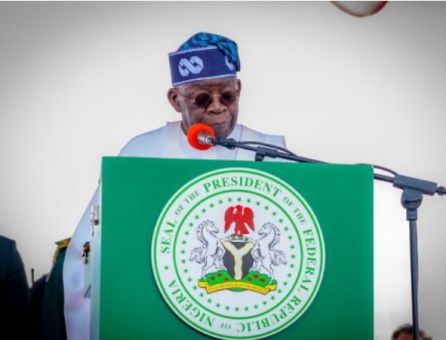
President Bola Ahmed Tinubu has called on Nigerians to unite in the fight against terrorism, banditry and kidnapping, stressing that insecurity cannot be tackled by government alone. In his Democracy Day broadcast marking 27 years of uninterrupted democratic rule, he urged citizens to avoid ethnic profiling and blame games, insisting that crime has no ethnic identity.
Referring to recent abductions in Oyo and Borno States, the President described them as a reminder that democracy cannot thrive without security. He expressed optimism that the abducted children would regain their freedom and said his administration had declared a security emergency, approved the recruitment of over 50,000 police officers and additional military personnel, and allocated N5.41 trillion to defence and security in the 2026 budget—the largest in Nigeria’s history.
Tinubu said Nigeria was shifting from conventional military exercises to precision targeting of terrorist networks, citing the destruction of an ISWAP command centre in Arege, Borno State, as evidence of progress. He added that 27 years of continuous civilian rule since 1999 showed democratic resilience, noting peaceful elections, legal dispute resolution, and orderly transfers of power.
Ahead of the Ekiti governorship election on June 20 and the Osun election on August 15, he urged INEC, security agencies and political parties to ensure credible and peaceful polls, warning that democracy weakens when citizens lose trust in elections. He also tasked the National Assembly, Judiciary, media and civil society with safeguarding democratic governance.
The President paid tribute to democracy heroes, including Chief Moshood Kashimawo Abiola and Kudirat Abiola, as well as pro-democracy figures such as Gani Fawehinmi, Bola Ige, Alfred Rewane, Abraham Adesanya, Anthony Enahoro, Balarabe Musa, Beko Ransome-Kuti, Frank Kokori, Arthur Nwankwo, Chima Ubani and the late Gen. Shehu Musa Yar’Adua, among others. Former President Muhammadu Buhari had earlier declared June 12 as Democracy Day in honour of the annulled 1993 election.
Tinubu also announced national honours for journalists, activists, lawyers, politicians, civil society leaders and military officers who resisted military rule, including individuals such as Richard Akinnola, Sam Omatseye, Babajide Kolade-Otitoju, Joe Odumakin, Ayo Opadokun, Ishola Williams, Joe Igbokwe and others, with several awards also given posthumously.
He further highlighted reforms across key sectors, defending his administration’s economic policies as necessary to restore stability, boost revenues, attract investment and strengthen transparency. He said domestic refining capacity had improved, reducing reliance on imported petroleum products.
On electricity, Tinubu said reforms under the Electricity Act had enabled states to participate in power generation and distribution, while efforts were underway to address metering gaps and settle sector debts through a proposed N4 trillion bond. He noted ongoing rural electrification projects supported by the World Bank and African Development Bank, aimed at expanding access to underserved communities.
The President also cited agricultural and economic progress, including deployment of 10,000 tractors under the National Agricultural Development Fund, certification of over 1,000 SMEs for export, and a 21 per cent rise in non-oil exports. He acknowledged ongoing hardship but assured Nigerians of continued efforts to reduce inflation, boost food production, create jobs and improve living standards.
Tinubu concluded that the aim of his administration is to move the country “from uncertainty to stability,” adding that democracy must ultimately translate into improved economic well-being for all citizens.