

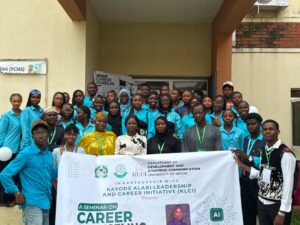
Students of the Faculty of Communication and Media Studies, University of Abuja, have participated in a practical workshop on the application of Artificial Intelligence (AI) to career development, aimed at bridging the gap between classroom learning and real-world professional practice.
The workshop, titled “The Role of AI Tools in Students’ Career Awareness in Communication and Media Studies,” was organised by 200-Level students offering the ICT for Development Communication course. The session was facilitated by Mr. Abdullahi Ahmed Aminullahi and Dr. Lateef Odegbenle.
During the workshop, students were introduced to Rafiki, an AI-powered career guidance platform designed to assist young Africans in gaining career clarity, accessing relevant opportunities, and making informed professional decisions.
Participants were encouraged to critically assess the technology from the perspective of emerging communication professionals.
Speaking at the event, the Head of the Department of Development and Strategic Communication, Dr. Aishat AbdulRauf-Salau, reaffirmed the department’s commitment to equipping students with practical competencies alongside theoretical knowledge.
She noted that communication education must continue to evolve in response to technological advancements.
“Our goal is to ensure that students do not merely learn about communication technologies but gain practical experience in applying them to solve real societal challenges. We are committed to preparing graduates who can thrive in an increasingly digital world,” she said.
Also speaking, Professor Nevelyn Batta, Professor of Strategic Communication, highlighted the growing significance of AI in communication practice and career development.
According to her, artificial intelligence is already influencing how communication professionals gather information, make decisions, and engage audiences.
“Students who understand its opportunities and limitations today will be better prepared for tomorrow’s workplace,” she added.
Representing the Dean of the Faculty, Dr. Barnabas Gbam commended the initiative, describing it as a model for contemporary university education and the application of communication technology for development.
He stated that the faculty remains committed to promoting innovative teaching approaches that encourage critical thinking, problem-solving, and technological literacy.
“Initiatives such as this expose students to practical solutions and reinforce the University’s vision of producing graduates who can effectively contribute to national development and the global knowledge economy,” he said.
In his remarks, facilitator Mr. Abdullahi Ahmed Aminullahi said the workshop reflected the core principles of Development Communication by demonstrating how communication and technology can be leveraged to address real-life challenges.
“The true value of communication education lies not only in understanding theories but in applying them to solve real-world problems. As educators, we must prepare students to navigate and shape an increasingly digital future through innovation, critical thinking, and practical engagement,” he said.
The organisers expressed appreciation to the Kayode Alabi Leadership and Career Initiative (KLCI) for partnering with the department to host the workshop. Special recognition was also given to Peace Agada, who represented the organisation and shared insights on career development and the transformative potential of AI-driven solutions.
The workshop forms part of the department’s broader commitment to experiential learning and preparing future communication professionals to harness emerging technologies for social impact, development, and career advancement.