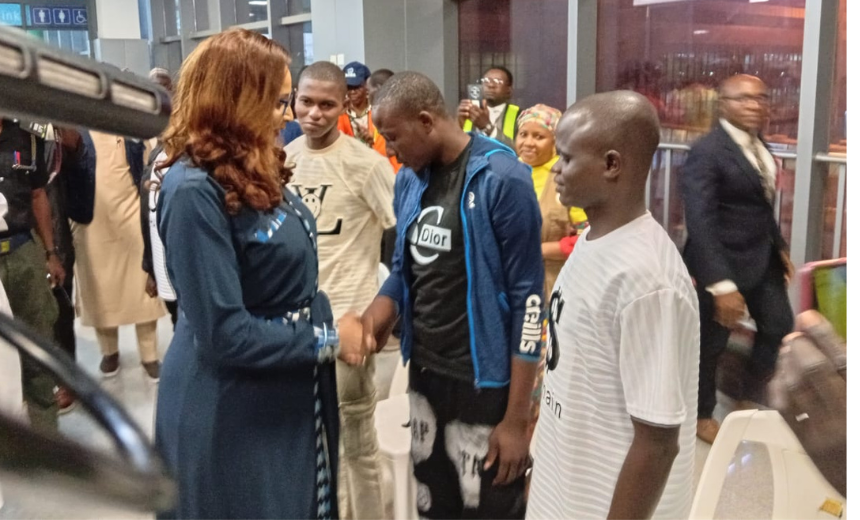
Five young Nigerians who were recently rescued by the Federal Government after being detained in MACA Prison in Abidjan, Côte d’Ivoire, since August last year, have returned to Nigeria.
The Minister of Foreign Affairs, Bianca Odumegwu-Ojukwu, disclosed this in a statement issued on Wednesday by her Special Assistant on Communication and New Media, Magnus Eze. The returnees were received at the Nnamdi Azikiwe International Airport in Abuja by the minister, alongside the Director General of the National Orientation Agency, Mallam Lanre Issa-Onilu, and other government officials.
According to the statement, six youths — Aliyu Malami, Nasiru Umar, Shamsu Abubakar, Sa’adu Bello, Lyman Mohammed and Usama Murtala — travelled by road from Sokoto to Abidjan on a trading trip and were arrested and imprisoned without charge or trial before the Federal Government intervened.
Odumegwu-Ojukwu said the matter was brought to her attention in April, prompting immediate contact with the Nigerian Embassy in Abidjan. She explained that sustained diplomatic engagements by the embassy and the Ministry of Foreign Affairs eventually secured their release.
The minister noted that Nigerian authorities were not informed of the detention, delaying intervention. She added that the detainees’ inability to speak French left them unable to communicate effectively or access legal representation in the French-speaking country.
Describing the case as a reminder of the risks associated with irregular migration, she said many Nigerians imprisoned abroad are vulnerable young people caught in unfamiliar legal systems. She disclosed that the Federal Government would pursue compensation from the Ivorian authorities over the incident.
Odumegwu-Ojukwu also cautioned Nigerians against embarking on risky journeys in search of opportunities overseas and said the government’s intervention was in line with President Bola Tinubu’s Citizen Diplomacy initiative under the Renewed Hope Agenda.
She further appealed to the Sokoto State Government to support the returnees through rehabilitation and skill acquisition programmes, noting that they had endured significant trauma and hardship and needed assistance to reintegrate into society.