

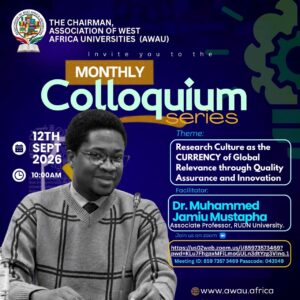
African universities have been urged to strengthen their research culture, quality assurance mechanisms and innovation capacity to improve their global relevance and influence.
The Chairman of AWAU, Professor Wahab Olasupo Ekbewole, welcomed participants to the webinar and emphasized the importance of connecting academic specialization with local realities.
The call was made by Dr. Muhammad Jamiu Mustapha, Executive Director of CEREDEMS Africa, during the September edition of the African and West African Universities monthly colloquium series.
Speaking on the theme, “Research Culture as the Currency of Global Relevance through Quality Assurance and Innovation,” Dr. Mustapha said universities must begin to assess the value of their research culture by examining their citation impact, international partnerships and influence on public policy.
He noted that Sub Saharan Africa contributes less than one per cent of global scientific output despite accounting for about 14 per cent of the world’s population.
According to him, fragmented research ecosystems, dependence on Western academic frameworks and journals, and the inadequate integration of indigenous knowledge remain major obstacles to Africa’s research development.
Dr. Mustapha called on African universities to develop research agendas that respond to local development challenges while establishing thematic research clusters capable of producing coherent and impactful knowledge.
He also advocated a shift from compliance based quality assurance to a system that uses quality assurance as a strategic tool for innovation.
The researcher proposed an 80 20 model in which 80 per cent of institutional research should align with university priorities, while 20 per cent should be reserved for individual intellectual curiosity.
He further called for the development of hybrid knowledge systems that combine indigenous African knowledge, Western academic frameworks and global best practices.
Dr. Mustapha presented a five step research roadmap for West African universities, including faculty led research agendas, thematic research hubs and stronger collaboration among universities, industry and government.
The session also featured discussions on journal rankings, local theories and strategies for increasing the visibility and impact of African research globally.