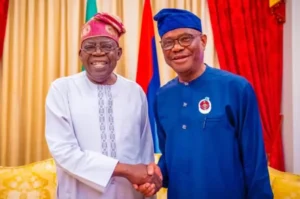
Fresh political tension is brewing within the ruling All Progressives Congress (APC) as powerful blocs in the party raise concerns that the Nyesom Wike-led Rainbow Coalition could undermine the party’s candidates and, ultimately, President Bola Tinubu’s re-election bid in the 2027 general elections.
The coalition, which brings together politicians and candidates across different political parties, has publicly declared support for Tinubu while simultaneously fielding candidates against APC contenders in several states.
Wike, the Minister of the Federal Capital Territory (FCT), has repeatedly defended the arrangement, insisting that the coalition is committed to securing Tinubu’s re-election and accusing his political opponents, including some APC governors, of targeting him because of his support for the President.
But the strategy has triggered apprehension among APC governors and other party stakeholders, who fear that fielding candidates under different party platforms could confuse voters and encourage split-ticket voting on election day.
Sources close to the APC governors said the coalition could weaken the President’s vote tally in states where its candidates are contesting National Assembly and governorship elections against APC candidates.
According to the sources, the concern was recently conveyed to President Tinubu during a meeting in Abuja, with governors reportedly warning that many voters, particularly in rural communities, may struggle to distinguish between the coalition’s support for the President and its opposition to APC candidates at other levels.
The concern stems from the possibility that voters could vote for Tinubu at the presidential level but support candidates of the Peoples Democratic Party (PDP) or other coalition-backed parties in National Assembly and state elections.
Political analysts have cited previous elections as examples of how voters’ preference for a presidential candidate can affect down-ballot contests.
The development has already generated political tension in states including Rivers, Kwara, Gombe and Cross River, where the coalition is making arrangements to challenge APC candidates while maintaining its public support for Tinubu.
Wike fires back
Wike has dismissed the concerns, maintaining that his political mission is clear: to secure Tinubu’s return to office in 2027.
Speaking during a media interaction in Port Harcourt, Rivers State, he identified Imo State Governor and Chairman of the Progressives Governors Forum, Hope Uzodinma, as well as Kwara State Governor and Chairman of the Nigeria Governors Forum, AbdulRahman AbdulRazaq, among those leading opposition to him.
Wike said the Kwara governor had accused him of sponsoring candidates against his preferred political choices in the state.
He argued that instead of attacking him, the governors should appreciate his role in providing a political platform for aggrieved APC members who could otherwise have joined movements directly opposed to Tinubu.
The minister also referenced his strained relationship with Uzodinma, insisting that personal disagreements would not prevent him from working for Tinubu’s re-election.
Wike has remained defiant about the coalition’s strategy, arguing that its members have the freedom to pursue different political interests at state and legislative levels while maintaining a common position on the presidential election.
The Rivers test
Rivers State has emerged as one of the major battlegrounds for the coalition.
The Rainbow Coalition was reportedly formed in the state in January 2026 during the political crisis between Wike and Governor Siminalayi Fubara and has since expanded to include political actors across the PDP, APC, Labour Party and other platforms.
The coalition has also endorsed former PDP caucus leader in the House of Representatives, Kingsley Chinda, as its governorship candidate on the APC platform, with Major Jack, the current Majority Leader of the Rivers State House of Assembly, as his running mate.
However, the arrangement has generated disquiet within some sections of the coalition, particularly among politicians from the riverine areas who question the choice of an upland candidate.
The emergence of other candidates, including ADC’s Gabriel Pidomson and NDC’s Dumo Lulu-Briggs, has further complicated the political contest.
Critics argue that Rivers voters could be left wondering which party or candidate the coalition ultimately wants them to support.
Dr Jackson Omenazu, Chancellor of the International Society for Social Justice and Human Rights, questioned whether the coalition was offering voters a genuine political alternative or creating confusion by presenting candidates under different party flags.
Similarly, an Action Democratic Party candidate, Desmond Stephen, accused the coalition of attempting to create the impression that the election had already been won, thereby discouraging voters from turning out.
Wike, however, has insisted that all candidates backed by the Rainbow Coalition will emerge victorious.
Kwara becomes another flashpoint
In Kwara State, the coalition’s activities have brought it into direct confrontation with the APC structure led by Governor AbdulRahman AbdulRazaq.
The political realignment intensified following the defection of Senator Saliu Mustapha from the APC to the PDP. Mustapha, who contested the APC governorship ticket and later faced the governor over the Kwara Central senatorial ticket, is now set to challenge AbdulRazaq for the senatorial seat in 2027.
Another former APC chieftain, Kolo Jiya, has also defected to the PDP and secured the party’s Kwara North senatorial ticket.
Two members of the Kwara State House of Assembly, Olushola Odetundun and Saba Yisa Gideon, have also moved from the APC to the PDP.
The development has deepened the political rivalry between the Wike-backed PDP structure and the APC in the state.
The Kwara chapter of the Rainbow Coalition was formally launched in Ilorin on August 26 under the banner of Otoge Progressives, bringing together aggrieved APC members and politicians from different parties.
Among political figures associated with the movement are Yahaya Oloriegbe, Kolo Jiya, Yahaya Seriki and Dele Belgore.
Reacting to the development, former Head of the Department of Political Science at the University of Ilorin, Dr Abdul Kareem Jimoh, said APC governors had legitimate reasons to be concerned about Wike’s activities.
Jimoh warned that while the coalition could serve Tinubu’s immediate political interest, its consequences could become more significant in the 2031 political cycle.
A media practitioner turned politician, Raheem Adedoyin, also criticised the arrangement, arguing that politicians benefiting from APC structures should not use the party’s resources to undermine its candidates.
Gombe, Cross River raise fresh questions
The coalition’s strategy is also playing out in Gombe State, where former Minister of Communications and Digital Economy, Isa Pantami, has reportedly moved to the PDP with the backing of the Rainbow Coalition.
The arrangement has raised questions about how coalition members intend to balance support for Tinubu at the presidential level with opposition to APC candidates at the state level.
In Cross River, the PDP and other opposition elements are also mounting challenges against APC candidates, including Governor Bassey Otu.
Hundreds of APC members have reportedly defected to the PDP in the state, further strengthening the opposition’s presence.
However, political observers say many PDP supporters may not be aware of the coalition’s reported plan to support Tinubu in the presidential election.
Dr Lyon Ebamane, a lecturer at the University of Calabar, argued that the strategy could fail because many PDP supporters would likely vote for the party across the ballot.
Analysts warn of possible backlash
Politics Editor of Arise News, Sunna Sambo, has also warned that the coalition could ultimately injure Tinubu’s electoral calculations.
According to Sambo, APC governors are concerned that voters may struggle to reconcile support for an APC presidential candidate with votes for opposition parties at the legislative and governorship levels.
He said the political developments in Rivers, including the reception given to opposition figures such as Peter Obi and Rabiu Kwankwaso, showed that the state’s electorate could not simply be assumed to follow the dictates of political leaders.
Wike remains confident
Despite the growing concerns, Wike has doubled down on the coalition.
Speaking in Abuja, he said Osun State Governor-elect Ademola Adeleke remained part of the Rainbow Coalition and would support Tinubu.
Wike also declared that the coalition would soon become more visible across the country.
He maintained that the opposition had no dominant political force capable of threatening Tinubu’s re-election and vowed to continue working to defeat his political opponents.
With the 2027 elections drawing closer, the central question now confronting the political landscape is whether the Rainbow Coalition can successfully deliver Tinubu’s presidential votes while simultaneously defeating APC candidates at the state and legislative levels or whether the alliance could ultimately create the very split in voting that its APC critics fear.