

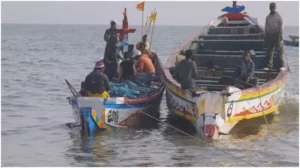
The Federal Government has moved to strengthen efforts to combat illegal fishing and maritime threats in the Gulf of Guinea through a proposed regional Marine and Blue Economy Policy aimed at improving security, attracting investment and promoting cooperation among member states.
The Minister of Marine and Blue Economy, Adegboyega Oyetola, disclosed this while presenting two draft policy documents to the Deputy Executive Secretary of the Gulf of Guinea Commission (GGC), Ambassador Obinna Agbugba, for consideration by the regional body.
According to a statement issued by the minister’s Special Adviser, Dr. Bolaji Akinola, the Commission had requested Oyetola to lead the development of a comprehensive regional Marine and Blue Economy Policy in a letter dated May 7, 2026.
Following the request, the minister said he established a multi-stakeholder committee comprising technical departments of the Federal Ministry of Marine and Blue Economy and its Department of Planning, Research and Statistics to develop the proposed framework.
The committee subsequently produced a draft Strategic Plan for the Development and Operationalisation of a Gulf of Guinea Commission Policy on Marine and Blue Economy (2026–2030), alongside a draft Policy Framework and Strategy Template.
Oyetola explained that the documents outlined strategic priorities, proposed interventions, performance indicators, implementation timelines, lead agencies and funding considerations to guide the implementation of the regional policy.
He said the proposed framework would strengthen collaboration among member states, encourage investment and support coordinated efforts to tackle illegal, unreported and unregulated fishing.
The minister added that the draft documents were developed in consideration of the 2025 Yaoundé Declaration and the work of the United Nations Task Force supporting the Commission’s 2026 Work Plan.
To ensure effective coordination, Oyetola proposed the establishment of a Steering Committee to oversee policy development and coordinate stakeholder engagement, recommending that the Federal Ministry of Marine and Blue Economy serve as its secretariat.
He also called for inclusive consultations involving member states, relevant institutions and other stakeholders to promote regional ownership and ensure that the proposed policy reflects the collective interests of participating countries.
Earlier, Agbugba commended Nigeria for developing its first National Policy on Marine and Blue Economy, describing the initiative as an important foundation for the Commission’s regional policy objectives.
Speaking on behalf of the Commission’s Executive Secretary, José Mba Abeso, Agbugba expressed confidence in Oyetola’s leadership of the policy development process.
Established on July 3, 2001, with its headquarters in Luanda, Angola, the Gulf of Guinea Commission comprises nine member states: Angola, Cameroon, the Republic of the Congo, the Democratic Republic of the Congo, Equatorial Guinea, Gabon, Ghana, Nigeria and São Tomé and Príncipe.
The proposed regional policy is expected to establish a common strategic direction for addressing maritime security challenges, protecting marine resources, combating illegal fishing and unlocking the Gulf of Guinea’s blue economy potential.