

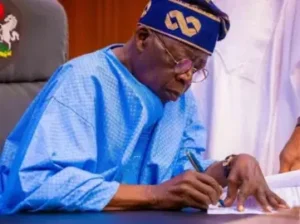
President Bola Tinubu’s approach to the 2027 presidential election is placing greater responsibility on governors, ministers, legislators and political allies to mobilise support for his re-election bid, raising questions about the strength of the ruling party’s political structure and the administration’s public support.
The strategy, as outlined in a commentary by public affairs analyst Ogundipe published by Vanguard, suggests an effort to organise the campaign around a network of political stakeholders rather than relying primarily on the President’s physical presence at rallies across the country.
The revised presidential campaign structure reportedly assigns all 32 APC governors responsibility for coordinating Tinubu’s campaign in their respective states. It also extends campaign roles to politicians outside the ruling party, including Nyesom Wike in Rivers State and the Federal Capital Territory, Chukwuma Soludo in Anambra State and Ademola Adeleke in Osun State.
Vice President Kashim Shettima and APC National Chairman Nentawe Yilwatda are identified as the President’s principal deputies within the campaign arrangement.
According to the analysis, the structure is designed to distribute campaign responsibilities across different levels of the political establishment, with governors leading state-level mobilisation, ministers defending government policies, legislators engaging their constituencies and party officials coordinating activities.
The approach reflects Tinubu’s longstanding involvement in coalition-building and political organisation, from his years in Lagos politics to the formation of the All Progressives Congress and his eventual emergence as president.
However, the commentary argues that organisational strength alone may not determine the outcome of the 2027 election, as voters are likely to consider the administration’s economic performance and their personal living conditions.
It identifies food prices, transportation costs, rent, electricity supply, education, employment and insecurity as issues that could shape public assessment of the government ahead of the polls.
While the administration has defended its economic reforms as necessary for long-term stability and growth, the analysis notes that their political value will depend partly on whether Nigerians experience measurable improvements in their daily lives.
The commentary argues that improvements in purchasing power, food affordability, electricity supply, employment opportunities and security could strengthen the government’s case for continuity. Conversely, persistent economic hardship could complicate the campaign’s efforts to persuade voters that the reforms are producing meaningful results.
It also highlights potential challenges within the campaign structure, noting that governors have their own political interests, succession plans, alliances and internal party disputes to manage.
Although their political interests may align with Tinubu’s re-election ambition, the analysis suggests that coordinating such a broad network will require balancing competing priorities across states and political groups.
The inclusion of politicians outside the APC further reflects an approach centred on coalition-building and electoral cooperation beyond strict party boundaries.
Nevertheless, the commentary cautions against equating the size of a political organisation with the level of public confidence in its candidate.
It notes that attendance at rallies, endorsements by governors and support from prominent political figures may not necessarily translate into votes, as individual voters will make their decisions based on their experiences, expectations and assessment of the administration.
The analysis concludes that Tinubu’s campaign structure could help extend the reach of his political message, but the President would still need to defend his record, explain his policy choices and demonstrate an understanding of the economic pressures facing households.
Ultimately, the effectiveness of the strategy may depend on the interaction between the ruling party’s mobilisation network and voters’ independent assessment of the government as Nigeria approaches the 2027 presidential election.