

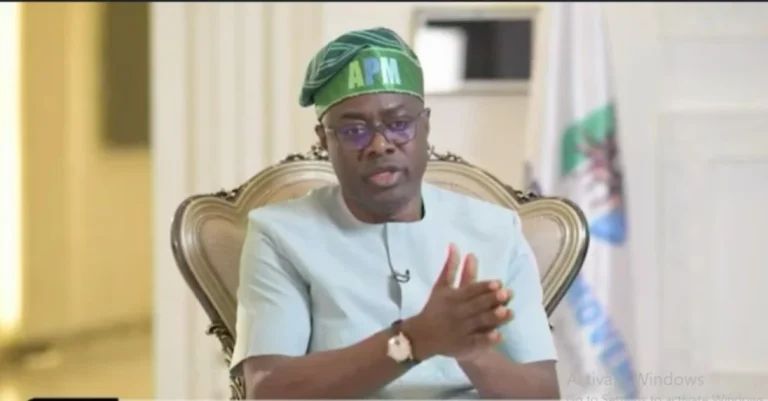
Oyo State Governor, Seyi Makinde, has declared his willingness to work with former Vice President Atiku Abubakar or former Labour Party presidential candidate Peter Obi in a possible opposition alliance to challenge the ruling All Progressives Congress in the 2027 presidential election.
Makinde disclosed that discussions among opposition figures were ongoing, saying he was actively involved in efforts to determine the most viable political arrangement ahead of the election.
Speaking in a Friday interview with ARISE News anchor, Ojy Okpe, the governor dismissed suggestions that he was merely open to an opposition alliance, revealing that consultations were already underway.
“We’re still discussing,” Makinde said.
Asked whether he was open to an alliance with other leading opposition figures, he replied, “Not only that I’m open, we’re actively discussing this.”
The governor, however, declined to endorse either Atiku or Obi as his preferred candidate, arguing that the opposition should rely on evidence, including candidates’ manifestos, previous performance and public sentiment, rather than emotions or personal preferences.
“To arrive at a decision, you need data,” he said.
He added, “We just won’t say, ‘Oh, okay,’ take emotional decision and say, ‘Oh, it’s you.’ We have manifestos now, we have certain things in that manifesto.
“We will sit down, we have maybe historical performance. We also have the sentiment of the people. All of those things will come together and arrive at a decision.”
Using his experience in the oil and gas industry to illustrate how political rivals could cooperate, Makinde said competing interests did not necessarily prevent parties from working together when circumstances required it.
He explained that companies operating in the same industry could compete, collaborate or enter commercial relationships depending on the demands of a particular project.
Applying the analogy to the 2027 presidential contest, he said opposition politicians could assume different political roles depending on the outcome of their consultations.
“Depending on what we see between now and the election time, we may be rivals, we may be collaborators, we may be — one may be the client of the other,” he said.
Alliance?
When Okpe asked whether he was prepared to work with others in pursuit of his campaign to “reset Nigeria”, Makinde responded, “To reset Nigeria, yes.”
Pressed specifically on whether he would work with Atiku if available data established that the former vice president was the strongest candidate around whom the opposition should unite, the governor answered, “Yes.”
“I’m willing to work with any Nigerian,” he added.
Makinde also cited the 1999 presidential election, when Olu Falae secured significant support in the South-West but failed to convert his regional popularity into victory at the national level, as an example of the challenges facing opposition politicians.
“Our biggest challenge is, first, to agree on what is the best course of action, and then seek an alliance,” he said.
The governor further referenced South Africa’s experience with political cooperation, arguing that competing political forces could negotiate an arrangement when circumstances demanded it.
He stressed that negotiations among opposition figures should not be driven by individual ambitions or personal interests.
That negotiation will not be anything personal,” Makinde said. “That negotiation will be the deal for Nigeria, by Nigeria
Makinde’s comments come amid growing consultations among opposition leaders seeking a common platform to challenge the APC in the 2027 presidential election.
The governor has consistently argued that personal presidential ambitions should not stand in the way of a broader opposition arrangement, maintaining that the priority should be identifying the political strategy most capable of defeating the ruling party.
Two coalitions, different projects
there are now two distinct political coalition projects shaping the 2027 election debate: the opposition’s effort to unite against President Bola Tinubu, and the Rainbow Coalition promoted by FCT Minister Nyesom Wike, which is mobilising support for Tinubu’s re-election.
African Democratic Congress emerged in July 2025 as the platform adopted by opposition leaders seeking to challenge Tinubu in 2027.
The arrangement brought together prominent politicians. Atiku joined the ADC in November 2025, while Peter Obi joined on December 31, 2025.
ADC subsequently sought to bring former Kano State Governor Rabiu Kwankwaso and his political movement into the arrangement.
However, disagreements over the presidential and vice-presidential tickets, among other political considerations, complicated the discussions.
In May 2026, Obi and Kwankwaso left the ADC and joined the Nigeria Democratic Congress where they emerged as presidential candidate and VP candidates respectively.
The ADC described their departure as a setback but insisted it was not fatal to its 2027 ambitions.
Despite the departure of Peter Obi and Rabiu Kwankwaso from ADC, opposition consultations have continued beyond the party as political leaders explore the possibility of presenting a common presidential candidate against the ruling All Progressives Congress in 2027.
In a report published on October 15, 2026, titled Single candidacy: Opposition leaders, parties in coalition talks, PUNCH reported that six opposition parties, Makinde’s APM inclusive — the ADC, Allied Peoples Movement, Nigeria Democratic Congress, Social Democratic Party, Peoples Democratic Party and Peoples Redemption Party — were involved in discussions towards a single candidacy.
Among the politicians involved were former Vice-President Atiku Abubakar (ADC), Oyo State Governor Seyi Makinde (APM), Obi (NDC), Adewole Adebayo (SDP) and Donald Duke (PRP).
The consultations, which followed resolutions reached at the G-100 opposition summit, were aimed at reconciling competing interests and identifying a common platform or candidate capable of challenging the APC in the next presidential election.
However, no consensus candidate had been announced as of the October 15 report, with discussions still ongoing.
Unlike the opposition coalition, Wike’s Rainbow Coalition is primarily designed to mobilise support for Tinubu’s re-election in 2027.
It is a cross-party arrangement rather than a merger of political parties.
Its members can support Tinubu for president while backing candidates from different parties for governorship and legislative elections.
Six political parties identified by PUNCH as participating, for instance, in the Rivers State arrangement, with Makinde’s APM included.
Others are APC, PDP, LP, APGA and AA.