

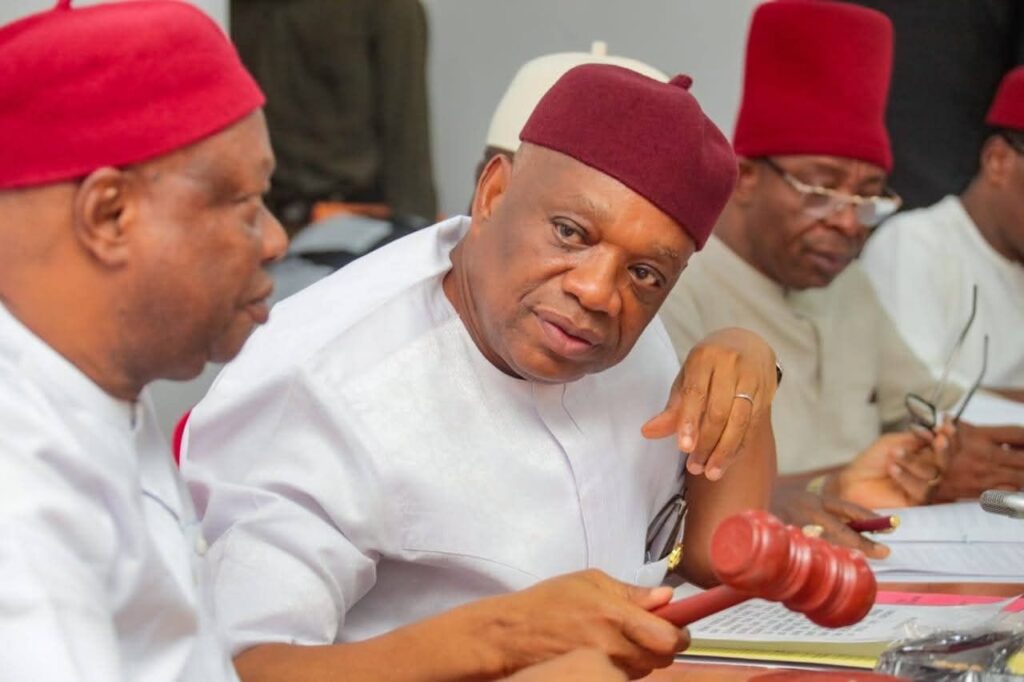
Senator Orji Uzor Kalu on March 2 played a prominent role in proceedings at the Senate Committee on Finance, reinforcing his commitment to institutional accountability, fairness, and economic reform.
The session, chaired by Senator Sani Musa, brought key financial institutions under legislative scrutiny, including the Corporate Affairs Commission, the Ministry of Finance Incorporated, and the Nigeria Sovereign Investment Authority.
The meeting formed part of the Senate’s constitutional oversight responsibilities, but it also reflected a leadership style that balanced firmness with fairness. Central to the deliberations was the appearance of the Registrar of the Corporate Affairs Commission, whose earlier failure to honor Senate invitations had drawn sharp concern from lawmakers. Prior to this session, the Senate had resolved to recommend his removal from office after repeated absences were viewed as a disregard for legislative authority.
However, in a turn that underscored the importance of due process, the Registrar appeared before the committee, tendered formal apologies, and provided detailed explanations regarding his earlier absence. He also outlined concrete steps to prevent such lapses in the future. Senator Kalu and his colleagues listened to the explanations and weighed the circumstances carefully.
In what observers described as a demonstration of mature legislative leadership, the committee withdrew its earlier recommendation for removal. The decision reflected a principle that Senator Kalu emphasized—oversight must be firm, but it must also be fair. By allowing room for accountability, apology, and corrective action, the Senate showed that its primary goal is institutional improvement rather than punitive measures.
The Corporate Affairs Commission plays a critical role in Nigeria’s economy, serving as the agency responsible for company registration and regulation. Efficient operations at the commission directly affect the ease of doing business and investor confidence. By ensuring that the Registrar addressed concerns and recommitted to cooperation, Senator Kalu helped steer the process toward stability and institutional strengthening rather than prolonged confrontation.
The committee session also examined the budget presentation of the Ministry of Finance Incorporated, widely known as MOFI. As the custodian of Nigeria’s federal government assets and investments, MOFI occupies a strategic position in managing public wealth. During deliberations, Senator Kalu reaffirmed the importance of repositioning the institution to meet modern governance standards.
A significant aspect of the discussion centered on repealing the outdated 1959 Act that currently governs MOFI and replacing it with a modern legal framework. Lawmakers agreed that the existing law no longer reflects current economic realities or global best practices in asset management. Senator Kalu’s contributions emphasized that reforming MOFI is not merely a technical adjustment but a necessary step toward transparency, efficiency, and better returns on national assets.
Nigeria faces mounting fiscal pressures, and government-owned assets must be managed in ways that generate sustainable value. By advocating for a modernized framework, Senator Kalu aligned himself with efforts to ensure that public resources are professionally managed and shielded from inefficiency. Observers note that his position reflects a broader push within the Senate to strengthen institutions rather than rely on temporary fiscal measures.
Attention then shifted to the Nigeria Sovereign Investment Authority, the body tasked with managing Nigeria’s sovereign wealth fund. The Managing Director of the NSIA presented a detailed account of the authority’s performance, achievements, and challenges. The institution’s mandate includes building savings for future generations, financing infrastructure projects, and providing stabilization support during economic downturns.
During the session, Senator Kalu raised direct questions about the volume of foreign investments attracted and the total revenue generated so far. His inquiries were framed not as criticism but as a call for clarity and measurable outcomes. He stressed that Nigerians deserve transparent information about how their sovereign investments are performing and what tangible benefits are being realized.
The NSIA has been instrumental in supporting infrastructure projects and stabilizing the economy during periods of volatility. Nevertheless, public confidence in such institutions depends heavily on open reporting and clear performance indicators. By pressing for detailed figures, Senator Kalu underscored his commitment to ensuring that sovereign wealth management translates into visible national gains.
Throughout the proceedings, a consistent theme emerged: accountability must go hand in hand with institutional support. Senator Kalu’s interventions demonstrated a belief that public institutions should not only answer questions but also receive the legislative backing necessary to perform effectively. His approach blended scrutiny with encouragement, reflecting an understanding that reform is most successful when it is collaborative.
Beyond the formal committee engagements, Senator Kalu also paid courtesy visits to fellow lawmakers, including Senator Victor Umeh and Senator Tokunbo Abiru. These discussions focused on issues central to legislative responsibilities and national development. Such consultations are often vital in shaping consensus around policy reforms and ensuring coordinated action within the Senate.
Political analysts observe that the March 2 engagements reflect Senator Kalu’s broader legislative priorities. Known for his advocacy of economic growth and institutional reform, he has consistently emphasized that Nigeria’s resources must be managed in ways that directly benefit citizens. His contributions during the committee session reinforced that message, particularly in the context of asset management and sovereign investment.
The withdrawal of the removal recommendation against the CAC Registrar stands out as a moment that combined accountability with compassion. Rather than allowing the matter to escalate into a prolonged standoff, the committee, with Senator Kalu’s participation, chose a path that preserved institutional dignity while reaffirming legislative authority. It sent a signal that the Senate remains firm in its oversight but open to reasonable explanations and corrective commitments.
At the same time, the scrutiny of MOFI and NSIA demonstrated that lawmakers are not easing pressure on agencies responsible for safeguarding national wealth. Calls for legal reform, transparent reporting, and measurable returns highlight a determination to ensure that economic governance keeps pace with global standards.
As Nigeria continues to navigate economic challenges and development demands, the role of the Senate Finance Committee remains pivotal. Through balanced oversight and proactive engagement, Senator Orji Uzor Kalu positioned himself as a lawmaker focused on strengthening institutions rather than merely criticizing them.
Rubby Obinna
March 2, 2026.