

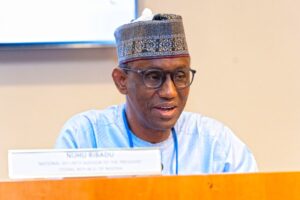
The Federal Government has destroyed more than 19,000 illicit weapons since 2022 as part of ongoing efforts to tackle terrorism, banditry and other security threats across the country, the National Security Adviser (NSA), Nuhu Ribadu, has said.
Ribadu disclosed this on Saturday in Sokoto during a multi-stakeholder dialogue on banditry prevention, containment and community resilience in the state.
The session, themed “Coping with Banditry in Sokoto State: A Multi-Stakeholder Dialogue for Prevention, Containment and Community Resilience,” was organised by the Sokoto Advancement Forum in collaboration with the Centre for Peace Studies, Usmanu Danfodiyo University, Sokoto.
Represented by Barrister Zakariyya Mijinyawa, the NSA said the administration of President Bola Ahmed Tinubu was strengthening the country’s security response through military operations, intelligence gathering, law enforcement, border security and cooperation among security agencies.
He identified Operation FANSAN YAMMA as a key platform for coordinating security operations across the North-West, adding that the government would sustain efforts to disrupt criminal networks and protect vulnerable communities.
Ribadu also cited figures provided by the Director-General of the National Centre for the Control of Small Arms and Light Weapons, retired DIG Johnson Kokumo, indicating that the centre recovered 5,449 firearms and destroyed 1,419 illicit weapons during nationwide operations in September 2026.
He said the figures underscored the importance of sustained weapons-control measures, including tracing recovered firearms and dismantling arms-trafficking networks to prevent weapons from reaching criminal groups.
The NSA stressed that military operations must be complemented by a sustained government presence in recovered communities to ensure lasting security.
According to him, the Office of the National Security Adviser is advancing a coordinated, whole-of-government and whole-of-society approach through the National Crisis Management Doctrine to improve preparedness and cooperation among relevant stakeholders.
For Sokoto State, Ribadu identified intelligence-led operations around vulnerable settlements, forest corridors and border communities as priorities for denying criminal groups safe havens. He said the efforts would involve support from State Forest Guards and NSCDC Agro-Rangers.
He also called for stronger cross-border intelligence-sharing, improved early-warning systems and prompt responses to security reports from communities, including Sabon Birni, Isa, Tangaza and Goronyo.
Ribadu further emphasised the importance of community participation, countering misinformation, protecting livelihoods and preventing the recruitment of young people into criminal activities through improved access to education and employment opportunities.
He, however, warned that reintegration programmes must not replace justice or reward violence, stressing that national security strategies could only succeed when communities translated them into practical local action.
The NSA commended the Sokoto Advancement Forum for its Blueprint for the Strategic Development of Sokoto State and urged participants to develop practical outcomes, including a community security and early-warning plan.
He expressed hope that the dialogue would contribute to a safer Sokoto where residents could live without fear, economic activities could thrive and public institutions could effectively protect citizens.