

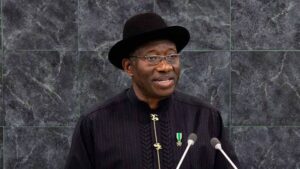
Former President Goodluck Jonathan and ex-Kano State Governor Abdullahi Ganduje have called on Nigerian political leaders to prioritise national interest, unity and good governance over personal ambitions and party loyalty.
The leaders made the call at the fifth National Conference of the Forum of Former Deputy Governors of Nigeria (FFDGN), held in Abuja from October 20 to 21, amid concerns over declining public trust, political divisions and the lack of continuity in governance.
The conference, themed “Rethinking Nation-Building: Bridging the Leadership-Citizen Disconnect Through Orientation, Attitude, Character, Culture and Tradition Towards Sustainable Development,” brought together political leaders, academics, diplomats and representatives of professional and civil society organisations.
Jonathan, represented by former Adamawa State Deputy Governor Bala Ngilari, said Nigeria’s interests must remain above those of political parties and individual politicians, warning that ethnic, religious and regional divisions continued to undermine national development.
He urged politicians to embrace competence, integrity and inclusiveness, stressing that political activities could only thrive in a peaceful and stable country.
“Nigeria must always be greater than any political party, individual or sectional interest,” he said.
The former president also urged former deputy governors to use their experience to mentor emerging political leaders, strengthen democratic institutions and promote constructive relationships between serving governors and their deputies.
He noted that governance required consultation, teamwork and strong institutions rather than the dominance of individuals.
In his remarks, FFDGN National Chairman, Dr Chris Alozie Akomas, warned that leadership without integrity and empathy could further widen the gap between government and citizens.
Akomas said sustainable development required more than government policies, budgets and administrative reforms, insisting that public officials must demonstrate accountability, humility and a commitment to serving the people.
“Power without character is destructive, while governance without empathy is an empty shell,” he said.
He added that public office should be regarded as a responsibility rather than a privilege, urging leaders to pay greater attention to the struggles of ordinary Nigerians, particularly vulnerable groups.
The FFDGN chairman also stressed that citizens had a role to play in rebuilding national values, noting that national renewal required collective responsibility beyond government action.
Also speaking, Ganduje criticised political defections driven by personal interests rather than ideological convictions, describing the weak ideological foundations of political parties as a challenge to Nigeria’s democratic development.
The former APC national chairman called on Nigerians to embrace their diversity and build a stronger national identity, warning that ethnic-based politics continued to impede national integration.
He also expressed concern over the lack of continuity between successive administrations, noting that disagreements between outgoing and incoming governors often resulted in the abandonment or reversal of ongoing projects and programmes.
According to Ganduje, such practices undermine sustainable development and prevent governments from consolidating on previous achievements.
He called for greater recognition of the contributions of deputy governors to governance, stressing that they should not be treated merely as substitutes for governors.
Former Delta State Governor, Ifeanyi Okowa, also identified the disconnect between government policies and citizens’ everyday experiences as a major factor weakening public trust.
Okowa said rebuilding confidence in government required a social contract based on accountability, inclusion and shared responsibility, adding that economic growth and infrastructure development must be accompanied by policies that address citizens’ expectations and aspirations.
Earlier, the forum’s Director-General, Kenneth Ibe-Kalu, reaffirmed the organisation’s commitment to promoting civic education, integrity and discipline as part of efforts to bridge the gap between political leaders and the people.
He urged participants to translate the conference’s deliberations into practical recommendations capable of strengthening national unity, improving governance and advancing sustainable development.
Jonathan, the forum’s Grand Patron, attended the conference, while Okowa served as co-chairman.