

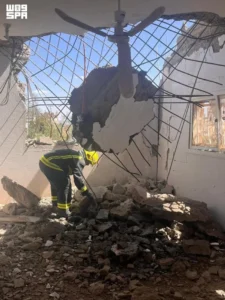
Yemen’s Houthi rebels have claimed another attack on Saudi Arabia’s capital, Riyadh, as senior officials from Saudi Arabia, Turkey and Pakistan prepare to hold talks with Iranian officials in Tehran amid growing fears of renewed regional hostilities.
Explosions were reported in Riyadh overnight on Sunday, while residents received text messages warning of a hostile aerial threat, following the Houthis’ claim of an attack on King Khalid International Airport.
In response, the Saudi-led coalition fighting the Houthis said it had struck missile launchers and storage facilities in Yemen.
The airport, which has repeatedly been targeted, has reportedly been largely closed since a major attack earlier this month killed 13 people and injured more than 300 others.
Saudi Arabia, the world’s largest oil exporter, has been deeply involved in the eight-month conflict since hostilities in its long-running war with the Iran-backed Houthis resumed in July.
Against this backdrop, Saudi Defence Minister Prince Khalid bin Salman is expected to join Pakistani army chief General Asim Munir and Turkish intelligence chief Ibrahim Kalin for Monday’s meeting in Tehran.
Iran’s security chief, Mohsen Rezaei, is also expected to participate in the discussions, according to Ali Bagheri Kani, deputy secretary of Iran’s Supreme National Security Council, who spoke to Iranian state television.
The visit follows warnings from the United States, Iran and Israel that fighting could resume, raising concerns about a wider escalation across the region.
The three visiting countries signed a defence alliance in Mecca in August, with their officials expected to discuss the security situation as tensions continue to rise.
Saudi security analyst and researcher Hesham Alghannam described the meeting as a critical opportunity to prevent further escalation.
“This historic meeting in Tehran may be the last chance before escalation spirals out of control, an attempt to impose a path of de-escalation before it’s too late,” Alghannam wrote on X.
He added that the participation of senior military and security officials suggested that the window for diplomatic intervention was narrowing.
Meanwhile, diplomatic efforts to ease tensions between Washington and Tehran have continued, with Qatar and Pakistan playing mediation roles.
Iranian Foreign Ministry spokesman Esmaeil Baqaei confirmed that a Qatari delegation visited Tehran on Sunday, adding that neighbouring countries were working to promote dialogue and reduce tensions.
“Our region is in the grip of serious tensions, and neighbouring countries are striving to convey a message and put forward initiatives,” Baqaei said on Monday.
Andreas Krieg, a researcher with London-based risk consultancy MENA analytica, described Prince Khalid’s presence in Tehran as significant, noting his role in Saudi Arabia’s diplomatic engagements.
Krieg said the visit demonstrated that Riyadh was actively engaging with regional developments rather than waiting for events to unfold.
He added that the Mecca alliance was signalling its readiness to cooperate with Iran on regional security and the protection of Saudi Arabia’s borders.
However, tensions have also been fuelled by statements from senior officials in Washington, Tehran and Tel Aviv.
Iranian Foreign Minister Abbas Araghchi said on Sunday that there had been discussions about the possibility of a new war, but maintained that Tehran’s policies remained unchanged.
US President Donald Trump also suggested on Friday that Washington could launch another military operation against Iran, referring to the US-Israeli campaign that began on February 28 as “Epic Fury”.
In Israel, Prime Minister Benjamin Netanyahu warned on Sunday that Iran and its allies could attempt to disrupt Tuesday’s Israeli elections through attacks.
“We have intelligence signs that our enemies, Iran and its proxies, could challenge us with attacks in order to disrupt the elections,” Netanyahu said.
“Don’t test us. You will suffer disproportionate blows,” he added.
Netanyahu’s remarks came amid reports by Israel’s Channel 12 of a disagreement between him and military chief Eyal Zamir over an unspecified new directive relating to the war with Iran. The prime minister denied the report.
The planned Tehran meeting comes at a sensitive moment for the region, with diplomatic efforts continuing alongside renewed attacks and warnings that hostilities could resume.