By Oyez Olatunde Rex
Something unusual is happening in Kwara’s early 2027 Election conversations. The focus is shifting from personalities and slogans, to the content of ideas.
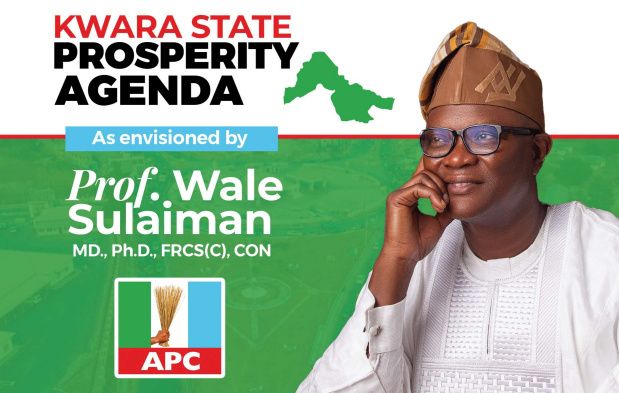
At the center of that shift is Prof. Wale Sulaiman, Commander of the Order of the Niger (CON), and the public unveiling of his manifesto, the Kwara State Prosperity Agenda.
Whether one agrees with him or not, the effect of that document is already visible: it has raised expectations. It is becoming harder for any serious contender to approach this race without a clear, structured plan.
What stands out first about the Kwara State Prosperity Agenda is its tone. It does not read like a list of promises. It reads like a working plan.
The ideas are organised around everyday realities, healthcare access, jobs, education, agriculture, and how the government actually functions. Instead of abstract language, the document leans on specific interventions: how services will be delivered, who benefits, and what systems need fixing.
For voters, this matters. It moves the conversation from “What will you do?” to “How exactly will you do it?”
Given Prof. Sulaiman’s background, it is no surprise that healthcare is treated as a system problem, not just a funding problem.
The healthcare component of the Kwara State Prosperity Agenda is built on a simple idea: every resident of Kwara should be able to access quality care without stress, delay, or financial hardship.
At the foundation of this plan is universal health insurance coverage, ensuring that no one is left out of the healthcare system because of cost.
But beyond access, the focus is on fixing how healthcare is delivered.
Primary healthcare centres, general hospitals, and specialist facilities are to be rehabilitated, equipped, and made functional across the state, not just in urban areas, but in communities where people often struggle the most to get care.
The plan also introduces regional specialist hospitals and health data registries, which will allow decisions to be based on real evidence rather than guesswork. Care delivery will be standardised across public hospitals, so that quality does not depend on location.
To improve efficiency and accountability, there is a proposal to deploy a unified Health Information Management System, a digital backbone that connects facilities, improves transparency, and attracts investment into the sector.
Beyond treatment, there is strong attention to prevention and public health education, promoting healthier lifestyles and reducing the long-term burden on hospitals.
Finally, the agenda looks outward as well, aiming to develop Centres of Excellence in specialised care, positioning Kwara as a destination for medical services and even medical tourism.
In practical terms, this is not just about building hospitals, it is about building a coordinated system where every part works together.
Education: From Schooling to Real Opportunity
The education plan moves away from the old pattern of schooling without direction. Its goal is clear: education must lead to opportunity.
The first priority is to reduce the number of out-of-school children, backed by a commitment to free and compulsory primary and secondary education across the state.
But access alone is not enough, so the agenda also introduces e-learning tools to support classroom teaching and expand reach.
There is a deliberate shift toward technical, vocational, and practical education, ensuring that students gain skills that can be used immediately in the real world. This is reinforced through curriculum reforms and structured internships, connecting learning directly to industry needs.
Teachers are not left out. The plan includes modernisation and retraining of teachers, so that teaching methods match current realities and student needs.
At the higher education level, the agenda encourages research and innovation targeted at solving local and regional problems, rather than abstract academic output.
There is also a forward-looking push to expand STEM and ICT training across schools, preparing young people for a digital and technology-driven economy.
To widen access, scholarships will be expanded through public-private and international partnerships, ensuring that financial barriers do not stop capable students from progressing.
Taken together, this is an education model that shifts focus from certificates to capacity, relevance, and employability.
Jobs and Employment: Creating Real Pathways to Earning
The employment component is built around a clear priority: creating real, sustainable opportunities for young people and the wider population.
The plan begins with attracting both national and international investments into key sectors such as agriculture, manufacturing, infrastructure, tourism, mining, clean energy, sports, and ICT. The idea is to open up multiple channels of economic activity rather than depend on a single sector.
At the same time, there is a direct focus on reducing youth unemployment through policies that promote decent work and fair wages, not just any jobs, but jobs that can support a stable life.
Skills development is central to this approach. The agenda emphasises vocational training and industry-aligned education, ensuring that people are equipped with skills that employers actually need.
There is also a deliberate effort to encourage entrepreneurship and innovation, especially by supporting small and medium-scale enterprises (SMEs) and startups. This creates room for individuals not just to seek jobs, but to create them.
The overall approach is practical: combine investment, skills, and enterprise support to build an economy where more people can participate productively.
Governance: Quiet but Important Reforms
Perhaps the most understated, but important part of the document is how it treats governance itself.
There is attention to:
Transparency in public spending
Measurable targets for government programmes
Accountability in service delivery
These are not dramatic proposals, but they go to the heart of why many public policies fail. Without systems that track performance and enforce responsibility, even good ideas lose their impact.
Why This Changes the Campaign
In previous election cycles, campaign conversations often stayed at the level of broad assurances. That approach is now under pressure.
By putting forward a structured, issue-based document early, Prof. Wale Sulaiman, CON has done two things:
He has given voters a benchmark.
People can now ask other aspirants: Where is your plan? How detailed is it?
He has shifted media engagement.
Journalists are more likely to ask policy questions when there is a document to reference. The conversation becomes more substantive.
Interestingly, one of the notable developments since the unveiling has been the spread of interest across different segments of society.
Students are discussing what the education proposals mean for them
Professionals are examining the feasibility of the economic ideas
Community groups are looking for how the plans touch their local realities
This kind of engagement suggests that people are not just reacting to a name, they are engaging with a set of ideas.
A Higher Bar Going Forward
The most important impact of the Kwara State Prosperity Agenda may not be who wrote it, but what it now requires of everyone else.
From this point on,
vague promises will be questioned more quickly;
Policy gaps will be more visible;
Candidates will need to show not just intent, but preparation to deliver.
In that sense, the campaign for Kwara 2027 is already evolving. The bar has been raised, not by rhetoric, but by documentation.
Final Thought
Elections are ultimately decided by voters, not documents. But documents can shape how voters think, what they expect, and the questions they ask.
The emergence of a detailed manifesto like the Kwara State Prosperity Agenda signals a shift toward a more informed political conversation in Kwara.
And if that shift holds, then regardless of who wins in 2027, one outcome is already taking shape: the standard for seeking leadership in Kwara State is no longer what it used to be.
Download the manifesto here
chrome-native://pdf/link?url=content%3A%2F%2Fmedia%2Fexternal%2Fdownloads%2F1003913052
Oyez Olatunde Rex is the Publisher of Rextun City Update