

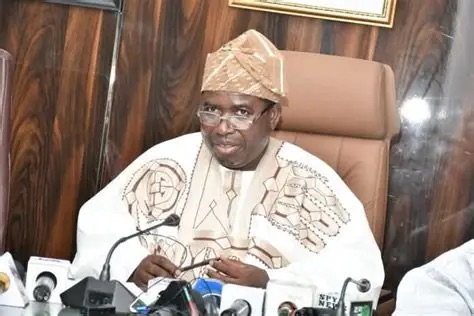
Prof. Joash Amupitan, The Chairman of the Independent National Electoral Commission, has warned that electoral officers found wanting in the 2027 general elections will face consequences.
Amupitan issued the warning on Monday in Lagos at the South-West Zonal Interactive Meeting with staff on readiness assessment for the 2027 general elections.
He said the Commission will not tolerate partisan behaviour, administrative negligence or any form of compromised ethics.
“Let me be unequivocally clear about the fact that partisan leaning, administrative negligence, or compromised ethics will not be tolerated.
“We will enforce our code of conduct, and every officer must understand that the protection of INEC’s institutional integrity is non-negotiable,” he said.
The INEC chairman reminded officers that neutrality is not optional, noting that the Electoral Act requires all election personnel to swear an oath of loyalty and neutrality.
“When you take that oath, you are committing yourself to administer an election in which you have no preferred candidate and no preferred political party.
“The question should never be: ‘Who will benefit from this decision?’ The question should always be: ‘What does the law require me to do?’ That is the discipline that protects both the electoral process and the electoral officer,” Amupitan said.
He also cautioned against cutting corners, saying officers must not invent informal solutions where the law and the Commission’s guidelines already provide clear procedures.
“Where the law provides a procedure, follow the procedure. Where the Commission has issued a lawful guideline or directive, follow it. Where an operational difficulty arises, escalate it through the appropriate institutional channel,” he said.
According to him, laws and technology alone cannot deliver credible elections if officials fail to implement them faithfully.
“A beautifully drafted Electoral Act cannot by itself guarantee a credible election. A sophisticated electoral technology cannot by itself guarantee integrity. The credibility of an election depends significantly on how faithfully the law is implemented by the officials entrusted with its administration,” he said.
Amupitan urged staff to know the law, understand their responsibilities, remain neutral, document their actions and protect the integrity of the process, stressing that every administrative decision may be subjected to public scrutiny and judicial review.
On preparations, the chairman said INEC has already commenced work for 2027 with focus on technology, voter registration, logistics, staff training and institutional integrity.
He disclosed that the Commission registered 10,772,421 voters during the three phases of the Continuous Voter Registration, subject to ABIS verification, and introduced printable Permanent Voter Cards in line with Section 18(1) of the Electoral Act during the recent Osun governorship election.
“Our goal is simple: no Nigerian who is eligible to vote should be disenfranchised by logistics. Every eligible citizen who registers must get their Card without friction,” he said.
He added that INEC is refining its Result Management System to make the journey of votes from polling units to the national collation centre visible and verifiable, including the recently introduced eEC8A, and applying a “Zero-Failure” protocol to address logistics challenges such as movement of sensitive materials, security coordination and training of ad-hoc staff.
“If Osun showed Nigerians what we can do, 2027 must prove to the world that excellence is our permanent culture, not an occasional coincidence. The success of the 2027 election will not be judged by the quantity of votes cast, but by the quality of the process,” he said.
Earlier in his welcome address, the Resident Electoral Commissioner for Lagos State, Prof. Ayobami Salami, said credibility is not built on Election Day alone but through early preparation and honest assessment of operational gaps.
He urged officers in the South-West to go beyond checklists and examine whether their systems, manpower, logistics, technology and security arrangements will withstand the realities of Election Day.
The meeting was attended by electoral officers, heads of departments and senior administrative staff across the South-West zone.