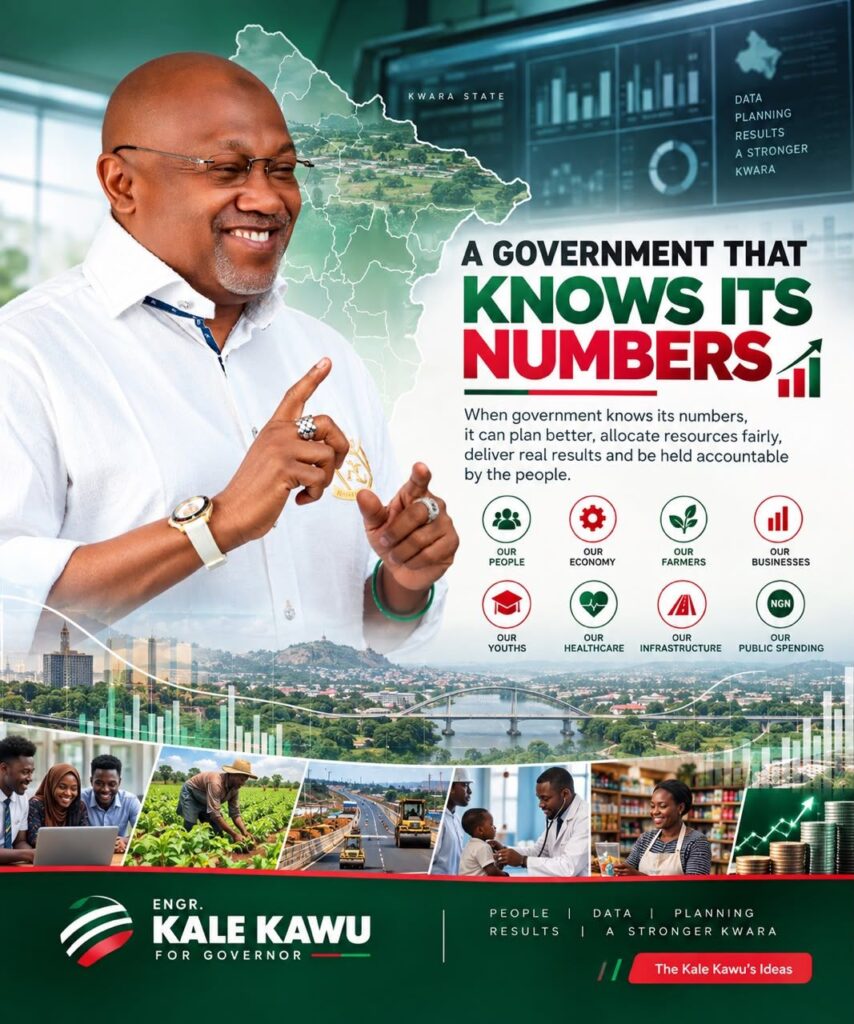
A government cannot effectively solve problems it cannot properly measure.
For too long, governance in Nigeria has often operated on estimates, assumptions, and incomplete information. We say we have unemployed young people, but we do not always know exactly how many, where they live, what they studied, what skills they possess, or what kind of work they are seeking. We say we have farmers, but how many are actually farming? What do they produce? On how many hectares? What challenges do they face? Who buys their produce? We talk about businesses, but how many operate in each local government? How many are growing? How many have access to finance? How many are struggling because of infrastructure or regulatory barriers? You cannot plan intelligently with information you do not have. That is why one of the most important reforms Kwara needs is not necessarily another building or another programme. Kwara needs a government that knows its numbers.
As governor, Engr. Kale Kawu will place data and evidence at the centre of government planning and decision-making, and the starting point should be a comprehensive understanding of the state itself. Government should know the communities it serves, the infrastructure available in those communities, the condition of public facilities, the economic activities taking place, the people who need particular interventions, and the results being produced by government programmes. This is not about collecting data for the sake of collecting data. It is about making government more intelligent.
If a local government has a shortage of healthcare workers, government should know exactly where the shortage exists. If a community lacks access to potable water, that should be recorded, mapped, and prioritised according to need. If a road is deteriorating, government should know its condition before citizens have to repeatedly complain. If thousands of young people possess skills but cannot find opportunities to use them, government should know what those skills are and where the gaps in the economy exist. The purpose of data is simple: to help government see reality before making decisions about it.
This should extend to public spending. Every major government programme should have a clear objective, a defined target, and measurable outcomes. If money is allocated to agriculture, we should know what increase in production or farmer income is expected. If money is allocated to youth employment, we should know how many young people are expected to gain sustainable employment. If money is spent on infrastructure, we should know what economic or social problem that infrastructure is intended to solve. And after implementation, government should return to the numbers. Did it work? If it worked, expand it. If it did not work, understand why. If something else works better, change course. That is how serious institutions learn.
Kwara also needs a stronger culture of transparency. Citizens should not have to rely on rumours or political arguments to understand what government is doing with public resources. There should be clear information about major projects: what is being built, where it is located, what it costs, when it should be completed, and what impact it is expected to have. A government that measures its performance can also be held accountable for it, and accountability should not be seen as an attack on government. Accountability is how government earns trust.
There is another important benefit. Good data can help government attract investment. An investor considering Kwara should be able to find credible information about the state’s workforce, land, infrastructure, agricultural output, industrial opportunities, markets, and economic sectors. Instead of simply telling investors that Kwara is open for business, we should be able to show them why Kwara makes economic sense. The same principle should apply across government. A governor should not have to depend entirely on verbal reports to know what is happening. Ministries should have performance dashboards. Projects should have timelines. Programmes should have measurable targets. Local governments should regularly report on key indicators. And the governor should be able to see, in real time, where government is performing well, where it is falling behind, and where intervention is required.
This is not about turning governance into a collection of spreadsheets. It is about creating a culture in which facts matter. Because when government knows its numbers, it can allocate resources according to need rather than noise. It can identify problems before they become crises. It can reward programmes that work. It can discontinue programmes that do not. It can measure progress honestly. And it can explain its decisions to the people.
Kwara does not simply need a government that is busy. It needs a government that knows whether its busyness is producing results. The ultimate objective should be simple. A government that knows where its people are. A government that knows what they need. A government that knows what resources it has. A government that knows where public money is going. A government that knows what its programmes are achieving. And, most importantly, a government that is willing to change when the evidence shows that something is not working.
That is what modern governance should look like. Not government by assumption. Not government by instinct. Not government by noise. Government by knowledge, evidence, and results.
That is the kind of government Kwara should demand.
And that is the kind of government we should build.
— The Kale Kawu’s Ideas.