

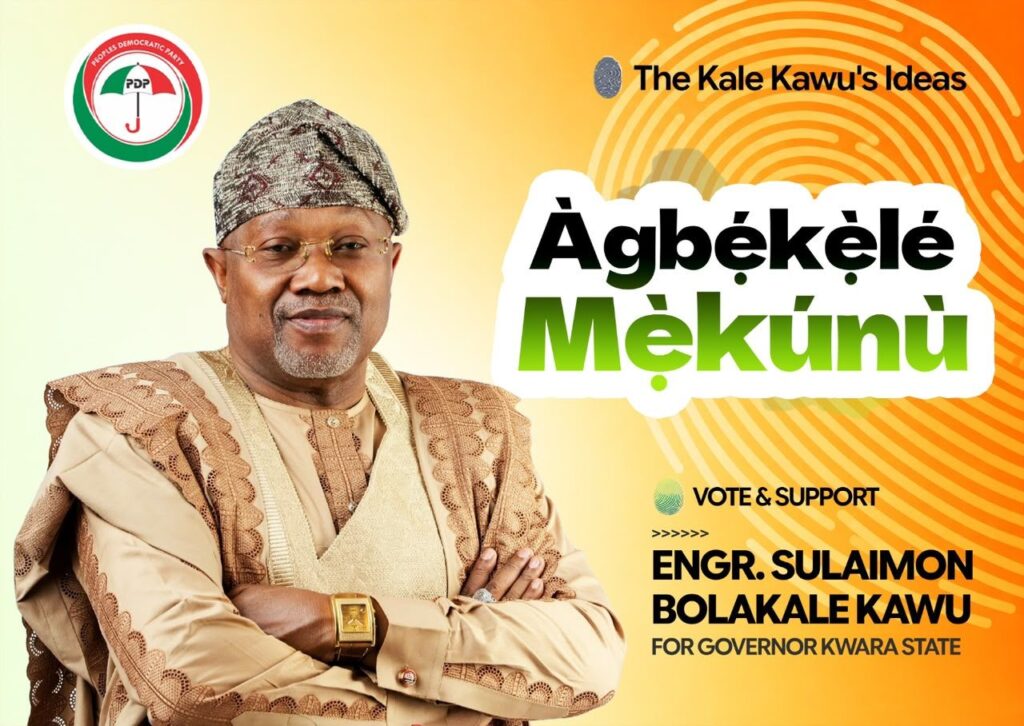
As Kwara approaches the 2027 governorship election, the emergence of Engr. Suleiman Bolakale Kawu, the Daniya of Ilorin, and his running mate, Rev. Fewenu, on the PDP ticket represents more than another political contest. It represents the possibility of a different approach to governance, one anchored in experience, competence, practical understanding and a clear sense of responsibility.
At a time when the people of Kwara are looking beyond political slogans and campaign theatrics, the Kawu–Fewenu ticket offers a preposition centred on one fundamental idea:
Government should work for the people, and leadership should be measured by what it delivers.
Kawu’s professional experience, including his time with the Rural Electrification Agency, brings a practical understanding of how government projects move from policy to implementation. His experience gives him an appreciation of the complexities involved in planning, financing, coordinating and delivering development programmes across communities.
That experience matters greatly in Kwara as it is presently lacking.
The state’s challenges are not abstract. They are visible in the daily lives of its people: infrastructure, electricity, agriculture, education, healthcare, employment and opportunities for businesses and young people.
These challenges would require more than speeches and announcements from ‘Ahmadu Bello house’. They would require a governor who understands the machinery of government and knows how to translate ideas into programmes, programmes into projects, and projects into measurable results.
That is where Kawu’s experience would become an important asset to Kwara.
His approach to governance would be rooted in the understanding that development is not achieved by publicity alone. It requires competent institutions, effective partnerships, proper planning, disciplined implementation and accountability for results.
In other words, the ‘Kawu idea’ is about moving government from announcement on social media to execution.
Kawu’s public profile also extend beyond his professional credentials, as the Daniya of Ilorin, he occupies a position associated with community, responsibility and engagement. That background would reinforce the kind of leadership he would bring to Government House. A leadership capable of engaging different sections of society and building bridges across political, social and community interests, in a diverse state like Kwara, that quality would be particularly valuable.
Kawu would use his opportunity to demonstrate that political authority does not have to create distance between government and the people. His leadership would be built around accessibility, consultation and an understanding that public office is ultimately a responsibility to society, this he has demonstrated all his life.
Authority would be matched with humility. Experience would be matched with accessibility. And political ambition would be matched with service.
The choice of Rev. Fewenu as running mate has further strengthen the ticket’s proposition. Modern governance demands more than the ability of one individual, It require a competent team capable of bringing different experiences, perspectives and strengths to the business of government, this combination is clearly lacking in the present set up of Gov Abdulrahman Abdulrazaq vs Elder Kayode Alabi.
The Kawu–Fewenu administration would therefore have the opportunity to present governance as a collective responsibility rather than a one-man project that Gov Abdulrahman Abdulrazaq has made it to look like.
The ticket would represent a government where competence would matter, institutions would be strengthened, professionals would be empowered to work and public resources would be treated as a trust belonging to the people.
The significance of the Kawu candidacy ultimately lies in the kind of political conversation it has create so far, for years, Nigerian politics has too often been dominated by personalities, jamboree rallies, induced endorsements, slogans and political theatre. But at the end, governance is ultimately judged by outcomes.
A government does not become successful because it announced a programme or has a beautifully enhances images, It becomes successful when that programme changed lives.
A road does not become useful because it was commissioned with cameras present. It becomes useful because people could travel on it safely and businesses could move their goods.
An empowerment programme would not be meaningful because beneficiaries appeared at a ceremony or made to do a video denouncing a political party, It would be meaningful when those beneficiaries could build sustainable livelihoods from it and a government would not be successful because it controlled the political narrative, it becomes successful because ordinary people could feel the difference.
That is the standard against which the Kawu–Fewenu ticket would ultimately distinguish itself.
A New Direction for Kwara
Kawu would bring to the 2027 contest an argument built around experience and capacity. His professional background provides him with an understanding of the mechanics of development. His community standing provides a foundation for engagement and social cohesion. And his partnership with Rev. Fewenu provides the basis for a team-oriented approach to governance.
Together, the duo offer Kwarans the possibility of a government that would place greater emphasis on competence, execution, accountability and inclusive development.
It would be a government that would understand that Kwara’s greatest resource is not merely its land or institutions, but its people, young people would need opportunities, farmers would need productive support, businesses would need an environment in which they could grow, communities would need infrastructure, professionals would need the space to contribute and citizens would need a government that listens.
The Kawu–Fewenu administration would have the opportunity to build precisely that kind of relationship between government and the people.
Ultimately, the 2027 election would be about more than who occupies the Government House, it would be about the direction Kwara must takes next.
The Kawu idea would represent a shift towards experience over inexperience, competence over political theatre, execution over endless announcements, and service over self-interest.
Kwara would not merely be choosing another set of occupants and bench warmers in Government institutions, It would be choosing the kind of people who can drive government that changes life positively, and with Engr. Suleiman Bolakale Kawu and Rev. Fewenu, that choice would offer the possibility of a new direction, one defined by experience, capacity, responsibility and a government that would work for all Kwarans.
A new direction. A new standard. A government that would deliver.